Posts

Showing posts with the label feminist

keeping her a little longer

Image
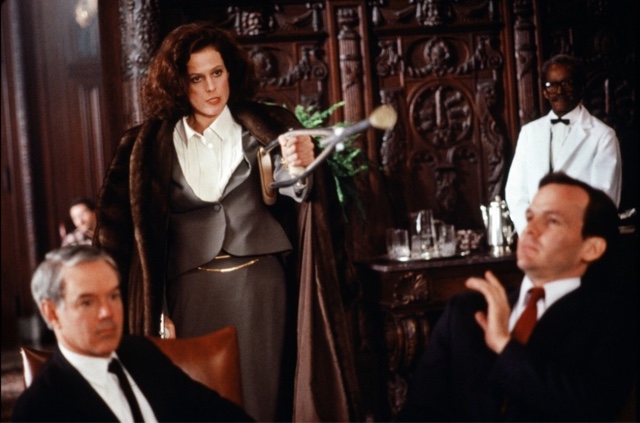
Opening narration: 53% of the American workforce is female. Three generations of women that turned 1,000 years of tradition on its ear. As little girls they were told to grow up and marry doctors and lawyers. Instead they grew up and became doctors and lawyers. They moved out of the "pink ghetto" and into the executive suite. Sociologists say the new working woman is a phenomenon of our time. Take JC Wiatt, for example. Graduated first in her class at Yale, got her MBA at Harvard. Has a corner office at the corner of 58th and Park. She works five to nine, makes six figures a year, and they call her the Tiger Lady. Married to her job, she lives with an investment banker married to his. They collect African art, co-own their co-op and have separate but equal IRA accounts. One would take it for granted that a woman like this has it all. One must never take anything for granted. Of course the narrator will not return; it's one of those openings. Plus, you know, the usual b...

i love to dress up and pretend

Image
Under the opening titles, as Patti LaBelle sings "Something Special" we see different women in different outfits, in blocks that never show the whole person. Parts of women, parts of outfits, earrings, eye makeup, and yesterday (because I had completely forgotten the acting class angle of Outrageous Fortune , I thought for a moment this was going to be about women working in fashion. But no. Cut to theatrical fencing class and Lauren is, to put it mildly, overeager. And we learn that her ambition is to play Hamlet. Cut to dance class. A gay guy who asks her out "to do some serious research" and she turns him down. Cut to Lauren and friend talking about not dating actors. They find the flyer for Korzenowski's workshop. Cut to Lauren outside her parents house in need of money. And I find myself confused because she could just do her own production of Hamlet with the $5000 her father gives her. And, Lauren's idea that Sandy can't go into an audition for...

better her than me

Image
Leia is awesome. It should go without saying. Especially after so many years. Many people have written about her (and about Carrie Fisher) over the years. And, Fisher herself has had plenty to say. For example, in Rolling Stone , 21 July 1983, she says, "There are a lot of people who don't like my character in these movies; they think I'm some kind of space bitch." She follows that up with: She has no friends, no family; her planet was blown up in seconds--along with her hairdresser--so all she has is a cause. From the first film... she was just a soldier, front line and center. The only way they knew to make the character strong was to make her angry. But, that isn't really true. 1) she may have friends. Star Wars Rebels has shown us recently that Leia was involved with the rebellion for a while before the events seen at the end of Rogue One and the opening of Star Wars , but even as a rebel, she could have friends. At home an Alderaan, maybe. Or she goes ou...

who are you? what can you be?

Image
(A note before this gets perhaps a little philosophical... Was it my sister Brooke who once commented in regards to an early Groundhog Day Project entry that I had a self-help book in me? I've toyed with writing a sort of self-helpy, memoiry book out of that first year of the blog. I even wrote a good chunk of what might have been the first chapter last fall. But, I don't know if I believe it anymore, myself--that there's a self-help book in me. Or maybe I don't want there to be... That wasn't the note. The note is this: I didn't really plan out this month of feminist and/or female-centric films. I immediately had an idea of a few movies I had to include-- Thelma & Louise , 9 to 5 , 10 Things I Hate about You --for a little obviousness and a little variety. And, I wasn't sure what movie should come last, like the coda to the rest. What movie would tie things together before I returned to Groundhog Day again for a day then moved onto some new month I ...

well, she is or she isn't

Image
And then there’s that moment that Patrick doesn’t kiss Kat. Ostensibly because she’s been drinking and might still not be entirely in control of her faculties, and he’s a better man than Joey will ever be. But, in that moment, that isn’t how Kat experiences it. Two things are going on. On the one hand, given her shorthand history , Kat expects a guy to take advantage (and when she's the one offering, it's not even taking advantage, so much... Except inasmuch as she has been drinking, but if that's true, she's hardly in a position to judge, and if she's sober enough to judge, then she's not drunk enough for it to be) or, on the other hand, she's in that moment feeling like a "normal" teenage girl and Patrick is rejecting her. Thing is, Kat can be both. A teenage girl who wants Patrick to kiss her and a self-avowed feminist who still might not like boys in general. (And, no smart person should like boys in general, because they're awful. W...

my insurance does not cover pms

Image
For example , Kat Stratford, 10 Things I Hate about You --she can’t just be enlightened because she noticed that the world is unfair, that girls are not given the things that boys are, the, you know the world sucks just because you’re a teenage girl; you don’t have to had sex and regretted it and he dumped her. She can’t just be a “shrew” because the world is an awful, unfair place. No, we’ve got to have something specific, something the males in the audience can understand. Because the males in the audience are either assholes who just won’t like Kat except as much as they think she’s hot, or idiots who will just be frightened by her. As Sage Young at Bustle , puts it, “The implication is that her shame and anger drove her into becoming interested in women's issues, possibly supporting the idiotic theory that female feminists are women who aren't loved up enough to accept second-class status.” Then Young counters with another interpetation, that “a trauma leads Kat to lear...

she isn't having any fun

Image
Thelma & Louise is one of those obvious titles, when you try to come up with feminist films. I was actually surprised watching the film today after many years since I last watched it, just how much of the film is virtually unrelated to the feminist core. It's that incidental feminism, or whatever you want to call it. Like if the leads were male instead, the plot wouldn't be that different. It would still be a road picture, there could still be the incidental violent act that sends the leads on the run. And, I take a moment to think of a male-centric example of the same and the first film that came to mind is The Legend of Billie Jean , which is entirely a feminist film. I know Bonnie and Clyde makes for a good comparison but it's been a while since I've watched that one, too. My mind turns to Kalifornia or Wisdom , though that isn't really a "road picture." To Hell or High Water , Natural Born Killers ... So much crime, deliberate and incidental. Th...

you can be smarter than him

Image
A couple things, and I'll keep this short today: 1) Sometimes I really like that the Internet is full of cynical assholes who hate everything; it makes some movies exceed my expectations after reading all the horrible reviews. 2) Sometimes the feminist story is not the one you expect. I saw Rough Night and Cars 3 today. The former is primarily about five women reuniting for a bachelorette weekend then accidentally killing a guy (and a whole lot more after that). The latter is--and I will include SPOILERS almost immediately--about an aging athlete learning to let go and allow someone new to take his place. That someone new is a younger woman. While Rough Night is basically a female-oriented update of Very Bad Things crossed with The Hangover , the most it does to raise up women is in its treatment, however brief, of the men they leave behind to go to Miami; the men are seen at a very sedate wine tasting, and talking about relationships, while the women are partying, doing drugs...

just some secretary

Image
Before I move on from Working Girl , there is something I need to say. I'm pretty sure Katharine is the wronged party in this film. She explains the existence of her note to Jack (which she never actually sends, by the way, which means at worst she only intends to steal Tess' idea, she doesn't ever do it until-- Well, I'll get to that.) as Jack being hesitant to look at a plan from her secretary, which makes sense. Sure, when Tess asks him if he would look at a colleague's idea, he says he would, but a) he doesn't know what she's talking about and might be distracted by the deal about to actually go down, and b) he might have been hesitant before to help Katharine because he just never liked her as much as he likes Tess, so Katharine would actually be telling the truth as she understands it, even if she would turn out to be wrong. Consider how the film plays the initial interactions between Katharine and Tess. Especially in context of the supposed ethical...

doesn't make me madonna

Image
Tess' McGill's obvious sins in Working Girl are being ambitious and knowing more than the men around her. In the 80s business environment, that is just not how it's supposed to be. Recently, Pamela Falk at CBS News reported that when Wonder Woman was named an honorary UN ambassador for women's issues, "some complain[ed] about her sexualized appearance." On CBS This Morning , Wonder Woman director Patty Jenkins "addressed the criticism by some that a supposed feminist icon like Wonder Woman can't also wear a sexy, skimpy outfit." She said: I think that that's sexist. I think it's sexist to say you can't have both. I have to ask myself what I would apply to any other superhero. This is fantasy and it's not for anyone other than the person having the fantasy. I, as a little girl, like took a huge amount of delight in the idea that for my power and my ability to stop that bullion that playground, I could also look like Lynda Cart...

it is what it looks like

Image
The plot of Working Girl is nothing that special. But, as with Wonder Woman , that is not the point. Or was not the point when this film came out in 1988. I was only 12, almost 13, when I saw this movie, plus, well, I was a boy. So, I was not really invested in Tess' upward trajectory as a woman. But, for one example (and my go-to reviewer), Roger Ebert said of the film: The plot of "Working Girl" is put together like clockwork. It carries you along while you're watching it, but reconstruct it later and you'll see the craftsmanship. Kevin Wade's screenplay is sort of underhanded in the way it diverts yes with laughs, and with a melodramatic subplot involving [Melanie] Griffith's former boyfriend, while all the time it's winding up for the suspenseful climax. Thing is, I don't find the climax to be all that suspenseful. It seems rather predictable to me. To earn, say, a more tragic ending--a failure--for Tess, the entire film would have had to...

you can't just order me

Image
You know what sucks? Not many female-centric films that are a) good and b) not explicitly (or obviously implicitly) feminist. Hell, tonight's has a woman invading the men's restroom within the first five minutes. (And, Jack (Harrison Ford) will be in the women's restroom later.) If that's not symbolic of what's to come, I don't know what is. It's Working Girl , by the way. It has been a while since I've seen this movie. I'm turning to the likes of Bitch Flicks again rather than my memory. Robin Hitchcock, returning to the film after a number of years, describes the film as "a product of its. time, when feminism meant a white lady achieving all the power and success normally reserved for white men." Her piece all suggests problematic areas like Tess' (Melanie Griffith) makeover, "putting down... woman [other than Tess] who've eschewed standards of feminine beauty and sex appeal. It's another aspect of Working Girl claimi...

lo non gli scendo incontro

Image
This entry should actually be short, partly because it has been a long day and I've got an early day tomorrow, and partly because I'm only watching a short film tonight. Aria by Pjotr Sapegin, a painful, beautiful little film that is all of ten minutes long. Today, as I arrived at Meltdown Comics in Hollywood to play Dungeons and Dragons , as I do every Sunday lately, I had to drive a different route than usual because of the Pride (and #Resist and #Equality) Parade. Friends of mine were out there marching. On a different day, I might have been out there. I marched on Inauguration Day, I marched the day after in the Women's March. And, I feel like I should be out there more, should be supporting those who need support, reinforcing those who need reinforcement, and renouncing those who need renouncing. On more than the Internet, I mean. Then again, as Ben Platt just said when he won for lead actor in a musical for Dear Evan Hansen , "don't waste any time trying t...

because of some idiot prejudice

Image
So a few pet peeves. One about something that happens in movies. One about how people react to movies. And one about life. I'll be as brief as I can. One, and this one occurred to me watching 9 to 5 , is when a conversation is split over two scenes. The example in 9 to 5 isn't even the most egregious example--Judy waits until she is at the store with Violet to ask about Doralee, when realistically she would have asked, you know, on the way there. Some movies, though, it's like midsentence, or between question and response, and that is not how people talk. It's a cheap manipulation of the medium. (To be fair, it can be used well, to suggest a conversation that happens again and again. Because one character just can't let something go, for example. But, too often it's just cheap.) Two, and this one occurred to me watching The Mummy , is about how people measure a film too much by what they wanted it to be. In this case, so many reviews referencing the 1999 The ...

spare me the women's lib crap

Image
Subtitle: thoughts on the film without the politics... if that's possible. For example, the costumes: Judy's. Outfit is far too conservative, far too reserved. While Violet's is looser, with a looser, Chinese pattern. to it. Her outfits are loose, practical, but her colors are subdued. (I rather enjoy Grace and Frankie and that's totally, if deliberately not explicitly a reunion of these two characters... Except I cannot imagine that Frankie ever worked an office job.) Doralee's costumes are somewhere in between, and far more showy. The office is stale, too practical, visually something out of the 50s with rare elements from the 60s--like Mr. Hart's office, a lot of Browns, a wood desk, wood paneling, but then some chairs that feel more modern (for 1980). One of the big changes, visually, later with the three women making the decisions, is that the office takes on a lot more color--very 70s. And, there's the scarf. Violet has to buy it for Mr. Hart...

expect to be treated equally

Image
...or better. Because, let's face it, when you keep a sex (or a race-- (Just note the early scene in 9 to 5 with the mailroom attendant Eddie Smith, a black man, who is upset by the new hire Judy (Jane Fonda) because he wants to be promoted out of the mailroom; the film acknowledges right away the problem is far bigger than just sex.) --or any group really) down systematically for, well, ever, it's going to take a little more than equality to make it right. Equal treatment isn't going to lift someone up enough--like Judy or Violet or Doralee here--that they would be anywhere near you if you've been lifted up since centuries or millennia before you were born. That is, lift up too unequal parties the same, they will still be unequal. Rich get richer and poor get poorer and all that. Men stay on top, women stay on the bottom, and the system runs as it has always run. Getting stuff like the changes the three leads make here at Consolidated Companies--job sharing, on-...

ours is the power, now is the time

Image
Stephanie Abraham explains (specifically coming back to Wonder Woman but the same applies for any film labeled as "feminist") in blog at Ms. : Now that the female superhero has finally made it to the big screen, critics and audiences are asking whether Wonder Woman is a feminist film. But the question itself is problematic. For one, it makes "feminist" a subjective adjective. Also, it suggests there's a monolithic Feminism, when really [the] feminist movement encompasses numerous feminisms in motion. The more inciting questions are: How does this film represent Wonder Woman? What's missing from this representation? And, what does it say about this particular moment in time? I especially love that last question. It's why every film can be taken as political. Every film is of its time, regardless of its subject matter, regardless of its setting. Every film can tell you something about the particular moment in time in which is was made, in which is was...