Posts

Showing posts with the label musicals

everything’s urgent to a democrat

Image
Coming on the heels of On Golden Pond , the central premise of Annie --that the presence of a kid will inject some life in an old man (though Daddy Warbucks is not as old as Norman Thayer, Jr, of course) is quite a cliché, but Annie is built of different stuff--a shallow surface of classist structures and a rags to riches plot that might as well be a romantic comedy (a little bit Pretty Woman ). Oddly enough, it is also a big departure from the comic strip. Oliver "Daddy" Warbucks was not even always a regular presence in the comic. In the place of Warbucks' secretary (or whatever her title is) Grace Farrell (Ann Reinking), there's a Mrs. Warbucks in the comic, and she is not the nice woman Grace is. She doesn't like Annie and sends her back to the orphanage more than once. (An orphanage run initially by Miss Asthma and then by Miss Treat.) The first time she tries to return Annie, a "society friend" sees her and she keeps Annie instead. Then Oliver ret...
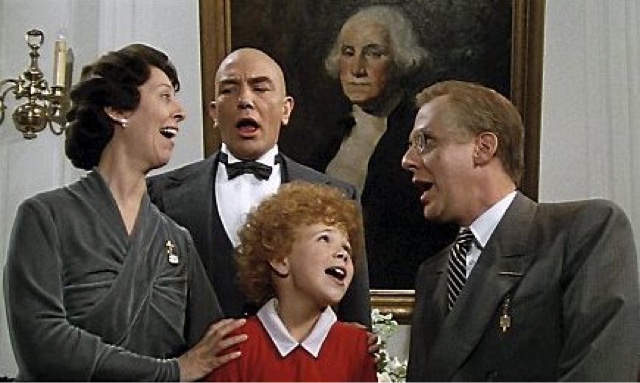
do i hear happiness in here?

Image
I've seen Annie live a couple times, for a History of Popular Culture class I read a bunch of old Annie comics... (Though I swear I didn't end up using any of those for the resulting paper. I wrote about some other comic that I had never heard of before that-- Bringing Up Father .) I saw the 2014 film version. (But not the 1999 one.) And, I have seen the 1982 film version of Annie more times than I can remember. And, a warning, if you don't like musicals, I've got three on my list for 1982. In fact, it might be very easy to establish up front what I got from 1982 films on repeat in my home--I got a love of musicals. Just last week, my daughter and I saw the new production of Disney's Aladdin at the Pantages. And, we're thinking of getting some of the rush tickets for the Pasadena Playhouse's production of The Pirates of Penzance . The film (and any stage production) is just the origin part of the Annie story, rounded out into a self-contained thing. T...

it's that time of the month

Image
You know what else Hedwig atones for? All of America's sordid history. Seriously, Hedwig and the Angry Inch is all about things divided, how we repair the damage, or cover it up. From the Civil War to Civil Rights, we've got a rather fucked up history full of divides and differences. And, however much we think we've got (metaphorically, of course) a good wig and makeup on, we're still split down the middle in so many ways. Hedwig tries to make up for that. Hedwig's at 17/15 by the way, on the Christ-Figuring scale. And, the completist in me wants to finish off the list. I also want to talk about America, about history, about life, about who and what we are. I would also love to write all about Hedwig's one liners and puns. Or the fact that Hedwig's mother's job in East Berlin was teaching sculpture to limbless children, which is immensely sad (unless they are all Buddhists or something and it's imaginary sculpture, like internal mandalas, and t...

face down on a piece of broken church

Image
There's danger ahead. See, I want to run Hedwig through the Kozlovic-Black scale, but I know my arguments regarding 15.75 atonement might offend some. Or should . Anyway, let's just do this. Hedwig is quite 1 tangible and 2 central and an 3 outsider . 3/3 Regarding 4 divinely sourced , Kozlovic (2009) explains, "Christ-Figures usually arrive onto the scene through some form of deliberate outside intervention, sometimes by a distant God-figure" (p. 6). The stress there is mine because obviously Hedwig is not in America because of a distant God-figure. He's there because of Luther... who coincidentally shares a name with the founder of a branch of Christianity. There is outside intervention. 4/4 Hedwig's birth is not exactly a 4.5 miraculous birth but Hedwig is born from Hansel because of an accident. I'm driven to Merriam-Webster for what should be a basic concept-- miracle . The first definition is "an extraordinary event manifesting div...

some slip of a girlyboy

Image
Hedwig. From the Germanic name Hadewig, derived from the Germanic elements hadu "battle, combat" and wig "war". Also, the name of, apparently, two different saints. Plus, on a very simplistic level, there's the pun on head wig . Hedwig is a character in conflict. With Tommy Gnosis. With Yitzhak. With the Angry Inch (the band). With her angry inch. With herself. She has little emotion but anger through most of the present storyline. While Yitzhak listens to Rent and wears a Rent t-shirt and auditions for (and gets offered a part in ) a traveling production of Rent ... Yitzhak is a romantic. He wants more than cold intercourse. He wants love. Or at least some sort of acceptance. On the other hand, Hedwig is stuck. She claims she's looking for her "other half" but she's just stalking Tommy. She cannot see what she has. She is too damaged. And, like another Tommy , she is a bit deaf and blind. Speaking of Tommy (which came up last week ...

but now you're interested, huh?

Image
(650) I was going to make a point today about performativity and performance... but then I thought maybe I'd already made it. Some scribbled notes on my copy of Brickell's (2005) "Masculinities, Performativity, and Subversion" that I wanted to share, and a quick Google search and I found the blog entry-- Day 557 - i think i hear a footstep --in which I typed up my scribbles word-for-word... I suppose you can go read that entry (which, ostensibly, was about Singin' in the Rain , by the way) but the basic gist was that all performance is performativity. That is, everything we do, even our subversions, our revolutions, are defined and con fined by what the world tells us we can get away with. I just recently started reading José Esteban Muñoz' (1999) book, Disidentifications: Queers of Color and the Performance of Politics . The gist I'm getting so far to his idea of disidentification is effectively finding your identity in the differences, the opposite ...

love the front of me, honey

Image
I've already pointed out how the musical offers "the greatest illusion of spontaneity and effortlessness" (Feuer, 1995, p. 447). Additionally, it offers timelessness, even in the midst of its story. The stage version of Hedwig , I've heard, is set during a single show, with the asides and flashbacks (and I hope animations) drawing on that. This film version offers several different shows and a linear plotline that covers probably less than half the film, with the flashbacks and asides and animations adding to that plotline even as they pull away from it. Flashbacks as memory--they don't exist in the past, they exist in the present. (I remember in my Media Theory class last quarter, we were talking about Groundhog Day , which happened a few times, and whether or not it was "Classical Hollywood Cinema." The professor had a problem with the nonlinear structure, but I argued that the film is actually quite linear. Phil's story is linear. It's just ...

one day in the late mid-eighties

Image
I feel as if I've told this story. It's not an elaborate, or remotely monumental, story. But, it's a useful story to establish some context for this week's film-- Hedwig and the Angry Inch . When this film came out, January 2001, it's not like I was busy with other movies. But, I was far from most movie theaters. I was living with my girlfriend at the time in Arkansas. That relationship was challenging but was going well right then. But, in Forrest City, Arkansas, the biggest city nearby, there was only one movie theater that I ever knew of, and it had three screens. I saw two movies there in the three months I lived in the area ( The Mummy Returns and Valentine ). It was a dark time for the movie-loving side of me. I knew of this movie, still. I still had my subscription to Entertainment Weekly (a subscription that has been continuous since 1994, but which I have recently chosen not to renew because by the time issues arrive, most of the information has alr...

no day but today

Image
In these dangerous times, where it seems the world is ripping apart at the seams, we can all learn how to survive from those who stare death squarely in the face every day and [we] should reach out to each other and bond as a community, rather than hide from the terrors of life at the end of the millennium. First of all, I'd change that ending to, well, ever; just cut it off at "the terrors of life." Forget the millennium ; live this every day. Reach out to people, connect. Second of all, those were some of the final words written by Jonathan Larson, found on his computer after his death. For those of you not paying attention, Jonathan Larson wrote the stage version of Rent . In his analysis of Rent , Scott Miller says quite succinctly (and obviously), " Rent is so many things to so many people." As it should be. As any movie should be. As any story should be. In Rent , we've got eight principal characters--Mark, Roger, Mimi, Maureen, Joanne, Angel, Col...

teens tonight

Image
It might not seem like the obvious link to connect Groundhog Day to those teen movies from the 1980s (or any decade) that I watched over the past month (or ever). But, there's a reason I refer to Phil's "adolescent" period when talking (or blogging) about this movie. First of all, that's how Harold Ramis refers to it on the commentary track, if I remember rightly. But, also, it just makes sense. Phil Connors, realizing the freedom inherent in the time loop, is like an adolescent sowing his wild oats. Pre-loop Phil is also like a teenager in that he thinks he knows everything, thinks he's better than everyone else and he is entirely self-centered and self ish . But, mostly, I don't want to talk explicitly about Groundhog Day tonight. I will note that the movie is going by unimaginably fast, like I'm so familiar with it, it almost isn't registering. I'd be tempted to stop typing and just focus on the movie, but who's got the time for that?...

it keeps the demons at bay

Image
A good chunk of what I am about to write, I figure, goes out to near-future me, writing away on his master's thesis. Don't fret. Don't be discouraged. This writing thing, after all, is what you do. My week with Across the Universe and my month with movie musicals comes to an end tonight. And, a part of me kinda wants to stay here, tucked away in the fantasy of it all. In the world of the musical, anything is possible and even heartbreak comes with a nice song and dance number. Well, maybe not dance. Three of the four musicals this month were built on existing songs, existing thoughts and feelings, existing emotional experiences... well, really, all four were built on existing thoughts and feelings and emotional experiences. Every movie is, musical or not. We can live vicariously in a film best when more parts of it are just close enough to be relatable to our realities. And when it's a musical we get to relate ourselves into, to commit a sort of method participation...

into the light of the dark black night

Image
Again, with Prudence. Aside from a few other women in the Vietnam sequence--and, apparently, she's one of them--she is the only Asian in the cast. Jo-Jo isn't quite the token African American, but he's close. And, his introduction plays on his race as a token story inclusion. The cover of "Let It Be" in this movie is amazing but the Detroit riot sequence as an introduction to Jo-Jo, in retrospect, is a bit... trite, obvious, manipulative, and simplistic. Nucho (2007) points out, rightly, that "revisiting the Detroit riots with a gospel version of "Let It Be" blaring in the background; in fact, it's a rather self-serving, arrogant gesture to use a Beatles song to represent the revolution against hundreds of years of brutality and racist oppression in the U.S." The problem is cultural/racial appropriation. There is no in-story reason for Jo-Jo to be African American. Sure, he's our stand-in for Jimi Hendrix, but when your story is stru...

all the little girls that look like me

Image
T.V. Carpio's Prudence is a lesbian, or at least attracted to women; let's not limit her simply because the film (perhaps, necessarily) does. I almost want to give her a specific label to counter the notion of Anne Thompson (2007) in Variety , who refers to "songs about confused sexuality, politics, war, race riots and psychedelia." I'll give you the last four, Thompson, but the movie never tells us that anyone in it is "confused" about her sexuality. Prudence quite directly points "I Want to Hold Your Hand" at a female cheerleader. And, Taymor makes this quite clear by letting the male football player stay in the frame just long enough that we in the audience might automatically assume he is the object of Prudence's affection then having him leave and the cheerleader look toward Prudence/us. That young woman is the object of Prudence's attraction. There is confusion but that arising in the audience from heteronormative impulses watch...