Posts

Showing posts with the label metaphor

just waiting for somebody to screw with

Image
I was not going to watch The Net again, but yesterday I noticed something... worth discussing. Here's the thing. Obviously, The Net is an early attempt to fathom the reach of the Internet and what it means to have our information out where anyone can find it if they just know how to hack the right website or database. But, then there's the plot itself--Angela (Sandra Bullock) has her identity erased and is sent on the run. Yesterday, I compared it to The Fugitive , the film version of which came out in 1993 (and I could also compare it to 1995's Nowhere Man TV show). (On the subject of The Fugitive , by the way, two things: 1) I watched the film just last week on the plane, indirectly. That is, guy in the row in front of me was watching it, and, somewhat familiar with the film, I didn't really need to hear the dialogue again to follow it. Not as good as when I watched Groundhog Day and the earphone splitter wasn't working, so I let my friend Pablo hear the mov...

not a story. it's the god's honest truth

Image
In my Oral Communication class, there's this bit in the book about how we use narratives to communicate. It's not that important to the overall curriculum, isn't on the final, but it makes for a fun lesson for the class. I ask for a story that everyone knows. We usually end up with a few fairy tale kind of stories-- Cinderella , Snow White , Little Red Riding Hood ... the latter works the best. With a little guided interrogation, I get my class as a whole to figure out together what sort of metaphors might be in the story. Neil Jordan's The Company of Wolves is a great elaboration on what eight classes have now come up with. Short version: it's all about sex and what a proper girl should do. Long version... well, read on. Movie starts with Rosaleen (Sarah Patterson) asleep, supposedly with a stomach ache, and it seems like an occasion is coming--she's got a new dress hanging in her room and her older sister has just arrived. (I think it's her sister's ...

me, me, me

Image
Phil Connors is not a werewolf. Let’s just get that obviousness out of the way. He is, however, quite a bit the adolescent, going through some changes that are, if not physical, quite significant nonetheless. (By the way, the last recap post here was Day 792 - time for the big bachelor auction .) I think I started referring to Phil’s hedonistic ventures in act two of Groundhog Day as his “adolescent” phase after Harold Ramis described it that way in his commentary track . But, it’s more than just good shorthand. (After that last recap, I drifted into horror films for October... like so: Poltergeist - 793 794 795 - and its remake - 796 The Shining - 797 , Room 237 - 798 - then back to The Shining - 799 - and its TV “remake” - 800 The Omen - 801 802 Damien: The Omen II - 803 The Final Conflict aka The Omen III - 804 The Omen (remake) - 805 Re-Animator - 806 Crimson Peak - 807 Hellraiser - 808 809 810 Hellbound: Hellraiser II - 811 812 813 Hellra...

all part of growing up

Image
Two things: 1) after getting all serious yesterday with Barthes and punctum , today I'm going with a movie I remember as fairly ridiculous and 2) for a ridiculous movie, this opening music and closeup on Scott Howard (Michael J. Fox) all sweaty and about to shoot a free throw is, well, far too serious, and a little full of itself. It has been a good long while since I'e seen this movie but "pretentious" is not at all a term I might be using watching it again. Anyway, Teen Wolf . I'm figuring this is going to be all obvious with the metaphor (like Ginger Snaps )--lycanthropy as puberty. (Or vice versa.) In a DVD extra with (I think) the third Ginger Snaps film-- Menstrual Monsters --Tanya Krzywinska, Reader in Film, Brunel University, references "old myths about transformation into animal form, and [how] a lot of those myths are about what it is to become uncivilized." In terms of the puberty metaphor, it is the hormonal teenager who is uncivilized. ...

she's begging for negative attention

Image
"I fear this is going to be offensive to women everywhere." - my daughter Saer as ginger Snaps begins again. Ginger to Brigitte: "Just so you know, the words 'just' and 'cramps' don't got together." Saer" That's true... story of my life. Nurse tells Ginger to expect the blood and pain for the next 30 years or so. Saer says--sarcastically, of course--"Yay!"         And she wandered off. Gotta love that aisle--"feminine hygiene" products opposite condoms and hair dye.   As the film continues, I'm wondering where the line falls between being offensive and commenting on the stuff that is offensive. Like Ginger's line--"A girl can only be a slut, a bitch, a tease, or the virgin next door." Sure, she's referencing what the world-- men --think about girls. But, the film never quite contradicts what she's saying here. Brigitte remains the "virgin next door" while Ginger quite lite...

they're just being normal teenage girls

Image
For some reason, Ginger Snaps is one horror film I have just never gotten around to. I just noticed on IMDb that is was made in Canada. That might be why I've been avoiding it, either consciously or unconsciously. Canadian horror films generally do not work for me... But, it starts well enough. Suburban neighborhood. Kid finds mutilated dog's foot in his sandbox. Turn to a couple teenage girls--sisters Brigitte (Emily Perkins) and Ginger Fitzgerald (Katharine Isabelle)--who apparently enjoy staging photos of themselves as dead bodies in various fatal circumstances. (That one of the lead characters is named Ginger makes me wary, like the the title is going to be a bit too literal in its figurativeness.) Brigitte and Ginger are the resident goth girls--they wear necklaces with bird skulls on them--in an otherwise (apparently) cleancut--as if that is inherently a contradiction--school. Requisite outcasts. Quick sidenote: I was looking up an image to use and realized why Em...

i am so exquisitely empty

Image
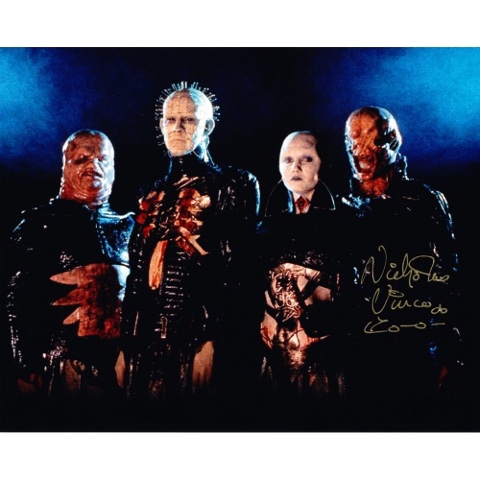
The thing about the Hellraiser franchise is is started as something different from other horror films. It wasn't just about a string of murders like a slasher film, or some last-minute empowerment of the "Final Girl" to kill the monster. Clive Barker has an interesting take on monsters that he shares with Nigel Floyd of Time Out magazine, September 2-9, 1987: I write the kind of horror fiction in which the monster has to be made peace with, one way or the other. Within the metaphorical world which I create it's not possible to throw the monster out and assume that one's house has been purged. The house can never be purged, because the monster is part of the texture of our internal workings. It's the metaphor thing. Like your classic ghost story, Hellraiser is not about the Cenobites but about Julia and her relationship with Frank, what she will do for him. Hellbound is not about the Cenobites or even Leviathan and Hell; it's about (again) Julia and...

i've come for my father

Image
There is at least the one female Cenobite. So, we could assume there's some civil war kind of split in among the denizens of hell, and Julia serves Leviathan and brings him Channard to be his body, in which case the homicidal joy in the last act of this film is not on Channard as much but on Leviathan. Structurally, Channard does serve as a sort of pseudo-Christ-Figure--and, not I'm not about to get into some Cinematic - Christ - Figuring ; don't need to. The guy willingly sacrifices himself, quite literally gets himself some stigmata, and has a giant penis attach itself to his head... Wait, that last one is not part of the Cinematic Christ - Figure . But, that penis is important to this third discussion of Hellbound: Hellraiser II because-- Actually, I've got to interrupt this entry because Kirsty was just telling Detective Bronson about fairy tales, and rather than thinking she's got no reason to connect the events of the first film to any fairy tale but jus...

what's your pleasure, sir?

Image
They could save each other, the way the poets promised lovers should. He was mystery, he was darkness, he was all she had dreamed of. And if she would only free him he would service her--oh yes--until her pleasure reached that threshold that, like all thresholds, was a place where the strong grew stronger, and the weak perished. - Clive Barker, The Hellbound Heart So, I wanted to watch all the Hellraiser films this month. However, the rule about sequels that I cited a few days ago is especially proven true by the Hellraiser series. But, I'm a glutton for punishment--and these films are all about punishment--so I was going to slog through it... Then, I came up with a clever notion--watch them in reverse order so they actually get better as I go. Brilliant, right? Except for the obvious catch--I would have to start with the worst of the lot, Hellraiser: Revelations , the ninth in the series, made so cheaply and so quickly (to hold onto film rights) that they couldn't eve...

keep this thing in the family

Image
I was thinking about trying to turn Poltergeist into a metaphor for marriage, but then the film just prominently started with the "Star-Spangled Banner" playing over a black screen and I'm wondering if there's not something more interesting going on here. I mean, as I remember the film--and I last watched it last year or the year before--is that there isn't much metaphor to it. The married couple are doing fine; they even smoke a joint together which is a nice cinematic visual for them being quite comfortable in their situation. The family is doing okay more generally. If anything, there's something about the cemetery property getting built on, or something about the ubiquity of television... That last thing would fit with the national anthem starting the film because the opening is actually a TV network going off the air for the night. You know, when they still used to do that. Maybe this is about the family idyll breaking. It starts with the daughter tal...

we have it on video

Image
The opening shot of Life as a House is a digital trick (one done much cleaner elsewhere, but not too bad for 2001)--the camera cranes down toward the shack, then through the window into the interior, focusing briefly on the model house that will be built later, then onto George in bed. The visual metaphor is simple: 1. we are being allowed into this man's life in an intimate fashion, 2. George is already being equated to that house and the shack; and 3. that house is inside the shack just as the idea of it, and the potential for its building is inside George. Additionally--and linked to #1 there--the window frame works as a stand-in for the frame of the camera, the frame of the movie screen, the frame of the TV as we watch the story begin. (That this window will soon not exist does not negate the metaphor because by then we're invested or explicitly disinterested.) At the end of the film, George will also see the finished house (looking as small as that model) through the ...

all this time i thought it was an act

Image
I've got a couple questions: Who is worse off-- Toy Story Buzz who thinks he knows who he is (with "years of academy training" in his memory) or Toy Story 2 Woody who doesn't know who he used to be (with years of cowboy adventures behind him)? Who are these toys, really? Hell, they choose to be toys; the "rules" are apparently voluntary and can be broken. They choose to live in servitude of an owner--recall Woody saying, "It doesn't matter how much we're played with. What matters is that we're here for Andy when he needs us. That's what we're made for, right?" It's a strange existence, built to be "played with" by others but having full consciousness of it. When Toy Story was on earlier--right now, I've got Toy Story 2 playing--I was talking with my daughter about there maybe being some metaphor or allegory for the practice of slavery in the way these toys exist for the sake of others... the differenc...

no. no second thoughts

Image
The opening shots of The Notebook evoke something peaceful, natural. Noah (though it might not actually be Noah in this instance) rowing in the early morning suggests something pastoral. Something timeless. In cinematic terms, it places the story within this film in the context of something bigger. There's a good reason, perhaps, that Noah has little more personality than crazy, borderline-stalkerish guy, who now 15 minutes in is seeming more free-spirited and maybe--just, maybe--a little less insane. He's the adolescent impulse to pursue the girl. That's it. Noah--his name even evoking something from long ago--is a guy who could be living in any time, any place, not just 1940s America. (Hell, after Allie leaves and he goes to war, his hair suggests someone who's a bit of an anachronism.) Gosling's character in Blue Valentine could be this same guy--and I don't mean to dismiss his acting ability; rather Noah Calhoun and Dean Pereira are like two ends of a spec...

in the kitchen

Image
What to do . Write blog entry . ... I can do it, too. ... So, there’s the metaphor. April is the turkey. It’s as simple as that. There’s a couple specific bits in Pieces of April where this makes perfect sense. Not a lot to say today, so I’ll just get into it. First of all, Wayne’s little speech about cooking turkey: It’s a common misconception that you can just stick a turkey in the oven. Turkey needs to be tended to. It needs to be cared for, lovingly. One must pay close attention to poultry... So much can go wrong. Turkey could burn in places, be overcooked, undercooked—which is a health hazard. And, what about basting? One gets the impression that April was neglected as a child, that her mother was always a bit of the bitch she has become with the cancer. One gets the impression that April’s damage has been with her for a very long time. And, she was never “tended to” and never “cared for, lovingly.” No one ever paid close attention to her. That’s why her family has no c...

it was just his time

I neglected to mention one particular media use of "Groundhog Day" yesterday. Al Logan Slagle, aka Allogan Slagle, according to his biography on UC Davis ' website, ...was a member of the United Keetoowah Band of the Cherokee of Oklahoma and worked as an attorney for the Association of American Indian Affairs (AAIA) in Washington, D.C. Prior to that he worked for the California Indian Legal Services in Oakland. He was the co-author of the book, The Good Red Road (1987). He completed his doctorate at Loyola University and was admitted to the California State Bar in 1979 then beginning his career in defending the rights of Native American tribes. His research included making use of National Archives Indian rolls, family genealogies, tribal records, and other documents to write petitions for Native American tribes seeking official legal tribal status. He was also a regular contributor to News from Native California magazine . I've found his column as far back as 199...