Posts

Showing posts with the label misogyny

who better than a crafty mountain man

Image
It barely matters that The Man from Snowy River is Australian; the messaging fits right in with American films of the time--a lot of masculinity on display in various levels of toxicity, men being men, women being submissive to those men even when they're not. Seriously, Jessica stands up to her father, he hits her, and she runs away and falls off a cliff to be rescued by Jim. (And, to be fair, as I have learned just now online, Australia also had a part in Vietnam, and in the 70s was undergoing a wave of nationalism.) And then, there's the overdramatic musical cues which almost ruin the lovely music everywhere else in the film. Brumbies arrive and the music lets us know their dangerous if we can't figure that out from the exposition-filled dialogue. The new Colt gets spooked by a dog and the dramatic musical cues jump in. The Stallion leader of the Brumbies tramples over Jim and we not only get overdramatic musical cues, we get insane freeze-frame closeups. And, ther...

i forgot to take the legs

Image
It comes down to this: is it funny that Phyllis' little monologue about her see-through nightgown disarms Winship and Tart? Yes. In fact, as Tim Conway points out in the commentary track (which I listened to yesterday ), if you watch Don Knotts' face through that scene, his reaction is so hilariously nuanced and complex, while Conway's is simple shock. These two detectives, already proven to be inept in just a handful of scenes, are taken aback, frozen, and that moment is emblematic of so much more. I've said before (and I will say again) that any movie is a window into the time it was made—a time capsule of the technology in play in making the film, a time capsule of the talent (or lack thereof) behind the film, a time capsule of the social and cultural structures in place at the time and in the place where the film was made, and a measure of the larger society around it. From the 60s into the 70s, Hollywood wasn't afraid to deal in sex or sexual innuendo. Phylli...

however dark the night

Image
Perhaps the lesson of The Idolmaker is that whether you're the one being used or the one doing the using, there's hope for you in the end. But, with new accusations of sexual harassment and abuse from men in power virtually every day lately, I figure those men get to the back of the line when it comes to hope. Seriously, the scene with Tommy Dee and the 14-year-old girl in the car is on and I see on my phone that Twitter is blowing up with comments about Trump supporting Roy Moore, implying that all of Moore's accusers are liars. It's like some sick sort of poetry. This is a movie in which the protagonist, the hero of the story, blames a young girl for being alone with his artist (though, he yells at Tommy Dee afterward, he then offers to hook him up when he wants a woman, so there's that), bribes DJs and (sort of) magazine editors for airplay and good press, yells at the woman he's with (and has already come on to), calls women "god damn broads",...

the only way you can show your feelings

Image
Women have been a plot device for male entitlement for as far back as stories were being told, as trophies for creepy behaviour, as the spoils of war, as the property of men, as the maiden-in-waiting for her adorable coercive, overly-persistent prince-charming. (Meagher 2015) Vincent Vacarri is not a nice man. He is our protagonist in The Idolmaker but he is not a nice man. In fact, he is at times an awful, awful man. Tommy Dee gets a young girl to accompany him to his car, ostensibly to get a copy of his record before it is officially released, and he tries to get more than that. We don't know how old Tommy Dee is, but he seems to be somewhere close to the age of the actor playing him--Paul Land was 23-24 when The Idolmaker was filmed. However old the actress in the scene is, Vincent says her character is 14. When Tommy Dee demands more than just a thank you, she kisses his cheek. He calls that sisterly, and goes for more. Vincent comes to her rescue. But, does he reprimand...

white woman crazy

Image
I decided on my titles for writing about The Villain on day one. For this one, I was going to, with tongue somewhat in cheek, talk about how this film portrays women, or wom a n. No, wom e n. There is, beside Charming, also the old woman that Handsome helps across the street. And, while Charming is rather idiotic in choosing to help her (with a bit of force) across the street simply because she's standing nearby, she is presented as a bit shrill. Handsome deserves her ire, but I can't help but point out that her ire is still presented as an overreaction. And, Charming--both oversexualized and cartoonishly demure. (It occurred to me last night, by the way, that when Cactus Jack asks Nervous Elk what he does with the white women after he captures them, it feels a little like maybe Cactus Jack doesn't know what men do with women any more than Handsome does. And, I'll return to that conversation later.) The film sends up the usual and has Charming be the one who want...

spread your blanket next to mine

Image
That a lonely degenerate like Donavan can learn to care about three orphans or the woman he's convinced to marry him for the sake of said orphans, is a nice thought. That two incompetent fools like Amos and Theodore can not only find one another to spend time with but also manage to (somehow)... thrive seems like the wrong word, but they seem to be doing okay. And, that's a nice thought, too. Then there's the--dare I say it--gender-nonconforming stagecoach driver who... Actually this one is problematic. Over the course of the plot, she is manipulated (nicely) into a sham marriage and being a mother to three orphans because that degenerate Donavan would rather run off to gamble in New Orleans. She has to--according to the film, anyway--eventually wear a dress, and earn Donavan's appreciation, if not his love. I already suggested yesterday that one detail isn't necessarily sexist--that Donavan is a bad parent figure because he's a selfish asshole and Dusty is...

who are you talking to?

Image
Still 1975. (Still not born yet.) Disney again. Except I was actually thinking about how different these childhood films are from the ones I watch now. Yesterday, for example, I watched mother! in the theater and I watched Adventures of the Wilderness Family at home. Today in the theater I watched Beach Rats and I'm watching The Apple Dumpling Gang now at home. Very different movies today. Very different movies today. I mean, you've got a big metaphor for human interaction with the universe, for religion, for male-female relations, for the cult of personality, sacrifice and self-sacrifice, and you've got a family running off to live in the wilderness and finding that some animals are nice and some are vicious... Which, really, taken simplistically, the themes could be much the same. But, Adventures of the Wilderness Family is just so innocent about everything. While mother! includes sex and violence and apocalyptic destruction as well as cannibalism. Meanwhile, Beach ...

what makes it happen

Image
A note before I begin: tonight's dinner is burritos and there are some chips and dip. This is the kind of meal we used to serve when we'd have people over to watch movies. Of course, there's no actual meat in the burritos anymore, as I'm a vegetarian now. But, it's an echo of the stuff we'd make when folks were coming over to watch a movie like this one... Most of the people coming over to watch movies happened in the latter half of the 80s and into the 90s, I'm pretty sure. But, this "month" is bundling all of it together. (Secondary note: apparently, I’ve been misnumbering the blog days for the last couple weeks and only just noticed. Today is Day 1141 even though I called yesterday 1040 on Twitter and Facebook.) Now, on to Adventures of the Wilderness Family one last time. One scene that undermines some of what comes later in Adventures of the Wilderness Family comes just after the family meets Boomer (the mountain man who wanders into the...

my insurance does not cover pms

Image
For example , Kat Stratford, 10 Things I Hate about You --she can’t just be enlightened because she noticed that the world is unfair, that girls are not given the things that boys are, the, you know the world sucks just because you’re a teenage girl; you don’t have to had sex and regretted it and he dumped her. She can’t just be a “shrew” because the world is an awful, unfair place. No, we’ve got to have something specific, something the males in the audience can understand. Because the males in the audience are either assholes who just won’t like Kat except as much as they think she’s hot, or idiots who will just be frightened by her. As Sage Young at Bustle , puts it, “The implication is that her shame and anger drove her into becoming interested in women's issues, possibly supporting the idiotic theory that female feminists are women who aren't loved up enough to accept second-class status.” Then Young counters with another interpetation, that “a trauma leads Kat to lear...

in the shadow of his ass

Image
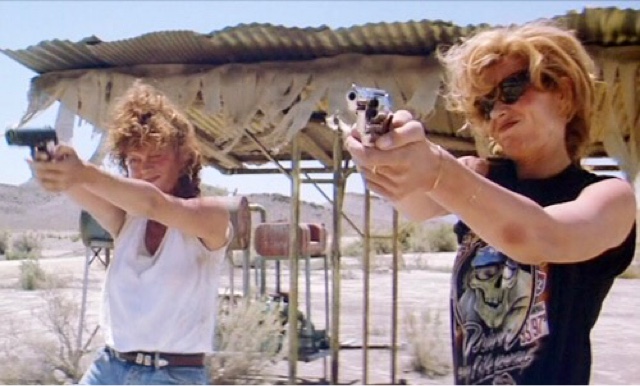
A few complaints before I move on from Thelma & Louise : The simple ones I mentioned in brief parenthetically yesterday . When Thelma and Louise need money, Louise needs Jimmy to get some to her. The talking through of their relationship that comes after her call to Jimmy is an interesting scene, and I'm not sure how the film would really play without it. Louise needs to realize both that she has that relationship waiting, that there is a chance for her in the regular world, and that--remember, when she can't tell him what's going on, Jimmy gets angry and breaks a lamp--even this relatively healthy relationship has an obvious problem: Jimmy is still a male, in a world where men can rage with jealousy and it's accepted. She keeps something from him and, generally speaking, we're supposed to see that as wrong. Here, she's actually protecting him from getting into legal trouble. But Jimmy is still of that man's world, and you don't keep information fro...

top five songs about death

Image
Rob Gordon lives in Apartment 2B. I don't know if that's from the book--I can't be bothered to check--or if it's even on purpose. But, I noticed it and noticeable things matter. Echoes of "to be or not to be" or maybe I'm reaching. But, in a story about a guy trying to figure out who he is, it makes sense. A corny, on-the-nose sort of sense. And then there's the deus ex machina of Laura's dad dying, without even the setup of him being sick. (The script tries to cheat by mentioning that her dad never knew she and Rob broke up because he "wasn't up to it.") Kinda ruins the movie the more I watch it. I mean, it was a lame bit of plotting in the first place. But, it gets more offensive with each viewing. But, I keep viewing anyway, because... (And, really, he just compared Charlie to 'Nam? That's gotta be offensive to someone.) Seriously, what is Rob's problem? You don't own every woman who's kissed you. Sex isn...

darkness comes early round here

Image
In his review of Lars von Trier's Antichrist , Roger Ebert, asks at one point, "Who can say what von Trier intended?" and, he points out that von Trier's "own explanations have been vague." My response is this: why should any artist need to explain his work, especially if you have been moved? (And maybe, as much as we resist this sort of thing, what is inferred is what was intended.) That being said, I am not recommending this film to just anyone. Most people will not like it, some might not get past the explicit sex in the very first scene. In black and white, in slow motion, with opera playing over it. (Sample lyrics, translated into English: "Leave the thorn, take the Rose; you go searching for your pain.") And a baby walks out a window and dies. That's the PROLOGUE. Hell, even a lot of von Trier fans won't like this film, I'd wager. But, I love von Trier's stuff, have since Breaking the Waves . (Plus, I'm the person--m...

time for the big bachelor auction

Image
Writing on the road, movie on the small screen of my phone beside me. On the way to San Diego for the weekend for a speech tournament. Today is the 2nd of the month so it's Groundhog Day . Like coming home again... Meanwhile, a quick recap of the past month of this blog [and here's the link to the last recap ]: One day with Groundhog Day turned into seven when I got into a newly discovered draft of the script and that opened a lot of old sections of my blogger brain. Groundhog Day - 762 763 764 765 766 767 768 I don't recall how I decided where to start the month, but I went with Say Anything ( 769 770 771 )--one of my favorite movies, and the first movie I watched with my ex-wife. I thought this might get me into an exploration of romance or something schmaltzy, and it almost did. The next movie was Better Off Dead ( 772 773 )-- (And, I still can't believe I didn't have the time in those couple days to get out to the location of the Meyer and Smit...

so sick of being picked apart by women

Image
Alyssa Rosenberg at the Washington Post calls Amy Elliott Dunne (Rosamund Pike) in Gone Girl "the only fictional character [she] can think of who might be accurately described as simultaneously misogynist and misandrist. In fact she hates pretty much everyone else on the planet, except, briefly, her husband Nick" (Ben Affleck). Like Chad Piercewell in In the Company of Men , yes, she seems to hate everyone. She may have only ever gotten together with Nick in order to have something that "Amazing Amy" doesn't have. (In case you haven't seen the film--and don't mind the inevitable SPOILERS that will happen in this blog entry--"Amazing Amy" is the children's book character created by Amy's parents. Amazing Amy tended to have it better than Amy did. As Amy puts it, "When I was 10, I quit cello. In the next book, [Amazing] Amy became a prodigy." Asked if she played volleyball, she adds, "I got cut, freshman year. She made ...