Posts

Showing posts with the label annie

let’s go to the movies

Image
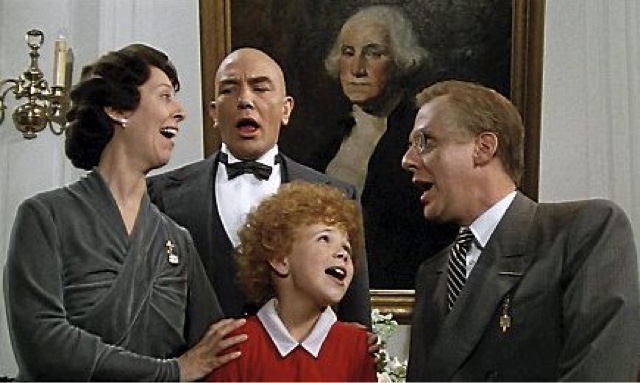
Interesting movie connection, since I also watched The Jerk ( 1185 1186 1187 1188 ) for this childhood deconstruction phase of the blog: Steve Martin was supposed to play Rooster in Annie but he and Bernadette Peters had recently broken up, so he opted out. Interesting movie connection: when Annie, Grace, and Daddy Warbucks go to the movies, they see Camille . First of all, the lyrics to the original-for-the-film-version song "Let's Go to the Movies" actually SPOIL the ending to Camille -- "and Greta Garbo is probably crying while Robert Taylor is locked in her dying embrace. --but second of all--and probably the reason Camille is the film used (even though, its class-divided romance plot relates to Annie somewhat)-- Annie 's supervising editor Margaret Booth also edited Camille back in 1936. The classist stuff of Annie is interesting, despite mostly being a shallow layer of flavor. By boiling down Little Orphan Annie to just her rags-to-riches or...

everything’s urgent to a democrat

Image
Coming on the heels of On Golden Pond , the central premise of Annie --that the presence of a kid will inject some life in an old man (though Daddy Warbucks is not as old as Norman Thayer, Jr, of course) is quite a cliché, but Annie is built of different stuff--a shallow surface of classist structures and a rags to riches plot that might as well be a romantic comedy (a little bit Pretty Woman ). Oddly enough, it is also a big departure from the comic strip. Oliver "Daddy" Warbucks was not even always a regular presence in the comic. In the place of Warbucks' secretary (or whatever her title is) Grace Farrell (Ann Reinking), there's a Mrs. Warbucks in the comic, and she is not the nice woman Grace is. She doesn't like Annie and sends her back to the orphanage more than once. (An orphanage run initially by Miss Asthma and then by Miss Treat.) The first time she tries to return Annie, a "society friend" sees her and she keeps Annie instead. Then Oliver ret...

do i hear happiness in here?

Image
I've seen Annie live a couple times, for a History of Popular Culture class I read a bunch of old Annie comics... (Though I swear I didn't end up using any of those for the resulting paper. I wrote about some other comic that I had never heard of before that-- Bringing Up Father .) I saw the 2014 film version. (But not the 1999 one.) And, I have seen the 1982 film version of Annie more times than I can remember. And, a warning, if you don't like musicals, I've got three on my list for 1982. In fact, it might be very easy to establish up front what I got from 1982 films on repeat in my home--I got a love of musicals. Just last week, my daughter and I saw the new production of Disney's Aladdin at the Pantages. And, we're thinking of getting some of the rush tickets for the Pasadena Playhouse's production of The Pirates of Penzance . The film (and any stage production) is just the origin part of the Annie story, rounded out into a self-contained thing. T...

whatever happened to working your way up?

Image
Note: today’s entry was mostly written while sitting in the waiting room while my car was getting maintenance, so access to some resources was limited.) The Jerk begins outside a movie theater--where a "comedy thriller" is playing--and includes director Carl Reiner as himself, with a direct reference to his filmmaking. (His going cross eyed because of Navin's Opti-Grab leads to Reiner to yell 'cut' too late while filming, which leads to a car crashing, actors die, and Reiner leads the class-action lawsuit against Navin.) These Hollywood references matter in a film that deals so much in issues of class. Navin grows up poor (and black) in the south. Upon getting to the city, he gets a low class job as a gas station attendant. He works as a carnie. It is sheer luck that he succeeds at all in his life; while it is Navin's ingenuity that leads to him making the Opti-Grab, that is the only evidence of any cleverness on his part (plus, perhaps, his delay of ...