Posts

Showing posts with the label class

i don’t know, i’ll make something up

Image
It's strange how some movies can be entirely familiar after decades, and some that were familiar once have slinked away out of my head. A few movies ago, I realized that somehow I had conflated Big Business and Outrageous Fortune as one big movie involving, I guess, two pairs of mismatched twins who also share a man and get involved with some sort of organized crime (I still can't quite recall what happens later in this film) and end up in the Mexican desert. Instead there's a genius acting instructor--Stanislav Korzenowski--and just two women (only one of them played by Bette Midler) who both audition for his workshop. And, I'm reminded of when I went to a Meisner workshop a couple years ago with my friend Christi from D&D, and it was fun but I had issues. For one, how the teacher described the way one plays as a child, becoming the thing you are playing at being, was exactly what I meant when I used the word "pretend" which was a semantic argumen...
change the world, make it better

Image
The thing about Baby is, she is already is someone who wants to make the world a better place. Maybe despite her parents—it's a little presumptuous to think they aren't all for her plans—she wants to join the Peace Corps. The Peace Corps had only recently begun. The first group of volunteers started training in June 1961. She references monks burning themselves in protest—Thich Quang Duc famously did so June 11 1963. Right before the film starts. And, she "wants to send her leftover pot roast to Southeast Asia" (sort of) and she plans to major in "Economics of Underdeveloped Countries"— (I find it odd that Neil tells her that he is "going to Mississippi with a couple of busboys, freedom ride." With a different tone, it could be a sarcastic response to her Peace Corps plan, like he doesn’t buy that a rich Jewish girl like her would deign to do that. Except, the actor playing Neil doesn’t say it that way. He says it like he means it. His reference ...

willing to stand up for other people

Image
I want to say coincidence, but I'm guessing there's something more involved than just chance. But, anyway, weird coincidence that Dirty Dancing came out just a month after Adventures in Babysitting and they both* begin with The Ronettes' "Be My Baby". (* This isn’t true but for whatever reason “Be My Baby” sounded just like “ Then He Kissed Me ” in my head and then even as I realized the mistake I was already writing.) Which at least distracted me momentarily-- trying to see if there was a producer or someone in the music department that worked on both these films --from the voiceover narration that lasts all of three sentences. The worst kind of narration, the useless opener because someone involved, probably the director, couldn't think how to establish place and time succinctly. That was the summer of 1963, when everybody called me "Baby" and it didn't occur to me to mind. That was before President Kennedy was shot, before the Beatle...

i love this story

Image
...the legend of Arturo, who was a Portuguese fisherman. He met this beautiful girl his first night in town--Catarina. And eventually they fell in love. But the problem was that Catarina's father was the territorial governor. He didn't want his only little girl running around with a lowly fisherman. So he told Arturo that he'd have to ship off. Which he did, but not before he told Catarina he'd be back for her. And when he came back, he'd signal with three long blasts, So she could dive off the rocks and swim to the boat, And they'd be on their way. So, a year later, everything went as planned. But when she was swimming out to the boat, The fog got so thick that she couldn't find the boat. Arturo panicked and he called out, "Catarina! Catarina!" Catarina yelled back, "Arturo!" With that, he just dove right off the boat into the icy waters, And they never found each other, And they both drowned. The legend is, They reu...

this is not shakespeare

Image
Trading Places begins with music from "The Marriage of Figaro" played over scenes from around Philadelphia. Eventually, we get to Louis' townhouse, Coleman bringing him breakfast in bed on a silver tray. It's ten minutes before we meet Billy Ray, and then only briefly. The film gives us a whole city, then positions us squarely in the high-class part of it. Billy Ray's outburst, grabbing Mortimer's legs feels (deliberately) out of place in the film we've got so far. When we are with him again a couple scenes later, he's over the top and it becomes clear that this film is going to play one of these things off the other. Even if we didn't know what the movie was going to be about, we'd know that the juxtaposition is deliberate. The film offers brilliant details like Louis bragging about his Rochefoucauld watch--that it tells the time in Monte Carlo, Beverly Hills, London, Paris, Rome, and Gstaad. Except, through a screenwriting mistake or, I su...

the first thing about human nature

Image
Something I didn't know the first time I saw Trading Places : it was supposed to be a Richard Pyror and Gene Wilder vehicle. Pryor dropped out. Eddie Murphy came in, got Wilder out (according to random trivia bit on IMDb) so he wouldn't look like he was "just trying to be another Pryor. Something I did know: Yoda, Marcus Brody, and Laurie Strode are in this. It's Christmas season. Louis Winthorpe III (Dan Aykroyd) is a commodities trader, rich, snooty, with a classy fiancé to match. Billy Ray Valentine (Murphy) is poor, he pretends to be a bling, legless Vietnam vet to beg for money. Their lives are about to get switched, because high concept comedy is a good start. Real classist deconstruction is where you go from there. Or where this movie goes from there. Billy Ray--who's black, in case you don't know who Eddie Murphy is, you cinematically uneducated miscreant--accidentally bumps into Louis--who's white, you filmically inexperienced buffoon--and pic...

let’s go to the movies

Image
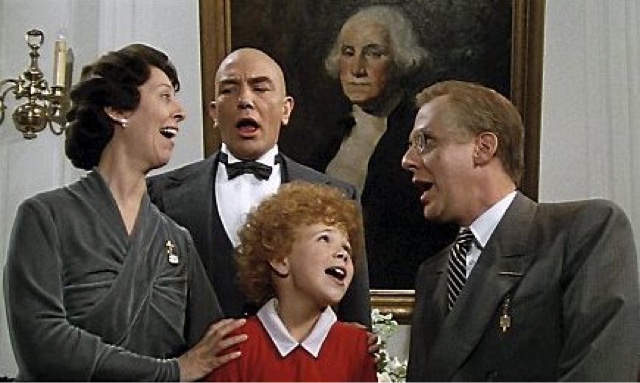
Interesting movie connection, since I also watched The Jerk ( 1185 1186 1187 1188 ) for this childhood deconstruction phase of the blog: Steve Martin was supposed to play Rooster in Annie but he and Bernadette Peters had recently broken up, so he opted out. Interesting movie connection: when Annie, Grace, and Daddy Warbucks go to the movies, they see Camille . First of all, the lyrics to the original-for-the-film-version song "Let's Go to the Movies" actually SPOIL the ending to Camille -- "and Greta Garbo is probably crying while Robert Taylor is locked in her dying embrace. --but second of all--and probably the reason Camille is the film used (even though, its class-divided romance plot relates to Annie somewhat)-- Annie 's supervising editor Margaret Booth also edited Camille back in 1936. The classist stuff of Annie is interesting, despite mostly being a shallow layer of flavor. By boiling down Little Orphan Annie to just her rags-to-riches or...

do i hear happiness in here?

Image
I've seen Annie live a couple times, for a History of Popular Culture class I read a bunch of old Annie comics... (Though I swear I didn't end up using any of those for the resulting paper. I wrote about some other comic that I had never heard of before that-- Bringing Up Father .) I saw the 2014 film version. (But not the 1999 one.) And, I have seen the 1982 film version of Annie more times than I can remember. And, a warning, if you don't like musicals, I've got three on my list for 1982. In fact, it might be very easy to establish up front what I got from 1982 films on repeat in my home--I got a love of musicals. Just last week, my daughter and I saw the new production of Disney's Aladdin at the Pantages. And, we're thinking of getting some of the rush tickets for the Pasadena Playhouse's production of The Pirates of Penzance . The film (and any stage production) is just the origin part of the Annie story, rounded out into a self-contained thing. T...

whatever happened to working your way up?

Image
Note: today’s entry was mostly written while sitting in the waiting room while my car was getting maintenance, so access to some resources was limited.) The Jerk begins outside a movie theater--where a "comedy thriller" is playing--and includes director Carl Reiner as himself, with a direct reference to his filmmaking. (His going cross eyed because of Navin's Opti-Grab leads to Reiner to yell 'cut' too late while filming, which leads to a car crashing, actors die, and Reiner leads the class-action lawsuit against Navin.) These Hollywood references matter in a film that deals so much in issues of class. Navin grows up poor (and black) in the south. Upon getting to the city, he gets a low class job as a gas station attendant. He works as a carnie. It is sheer luck that he succeeds at all in his life; while it is Navin's ingenuity that leads to him making the Opti-Grab, that is the only evidence of any cleverness on his part (plus, perhaps, his delay of ...

this is the thing that they'll know me for

Image
On the first or second day of my public speaking classes, I talk to my students about a couple things that I was thinking about tonight. Eye contact and the differences (and similarities) between a speech and a conversation. Regarding eye contact, at some point, I tell them a couple things. Don't think of your speech like a speech. You don't have to talk to all 20 or 30 or 40 students at once. You can just talk to the one you're looking at at any given moment, for any particular sentence. It's just you and them, in that moment, with that idea. And, if you really need validation for something you're saying-- And maybe I recount the story of how at the state speech tournament my senior year in college, I had a particularly emotional dramatic interpretation piece and it made the climax so much easier for me to embrace the sadness of it if I had someone in the audience buying into that sadness as well. There was this girl Chelsea--competitor of mine I had only met tha...

these are your people

Image
Permit a sidetrack. Not that there's a clear throughline driving me this month. I wanted to revive this thing and I did, and I've mostly just been winging it. One day at a time. Life is good that way. Make plans, sure. But, it's each day that matters. Do the useful things, the productive things, but also find time for the fun things. Save Buster from choking and light a woman's cigarette... Not that I want to get into Groundhog Day references right now. King Arthur is today's film. And, what TV Tropes calls "Cast Calculus" (or more specifically, depending on how this goes, "The Five Man Band" or The Magnificent Seven Samurai"), and The Encyclopedia of Fantasy labels simply as "Seven Samurai." Specifically, because lately I think about way too much in terms of Dungeons and Dragons references (because D&D takes up far too much of my spare time), I noticed as I watched King Arthur last night that Arthur and his Knights p...

i don't get caught up in all that stuff

Image
Something interesting about yesterday's movie-- Can't Buy Me Love --and today's-- Lucas --that many people wouldn't notice is the opening shot. Can't Buy Me Love , you might remember, starts with Ronald on his riding mower, except not quite. It actually begins with a shot of cactus in the foreground, a little bit of sky above, then Ronald comes into view in that gap between the cacti. (There's a nice echo in that the movie also ends with Ronald on his mower, of course.) And, this movie begins with a closeup on a bug. The title character (Corey Haim) is fascinated by insects, of course. And, insects will be important at a couple points later in the film. But, also, these visuals make for some simple metaphors--Ronald (and his friends as well) is like cactus; other (more popular) people don't want to get close to him or be around him. Similarly, Lucas is an insect--most people just don't want to be around him. (Hell, his nickname is Leukoplakia, which ...

some right to life working out

Image
(Got a mention on reddit today, so there have been some new readers today--a nice jump in pageviews. Thing is, they're probably looking for Groundhog Day . Recently, I spent another week ( 762 763 764 765 766 767 768 ) with that film, and I still watch it once a month, but my 365-days-in-a-row ended more than two years ago. Lately--i.e. phase three--I try to watch a different movie each day, but occasionally they repeat if I've got more to say (like today). I'm writing my Master's Thesis about writing this blog (primarily that first year with Groundhog Day ) and there's been talk about a book, but I haven't had time to look into that possibility just yet. Meanwhile, there are movies that need watching; and mostly, I pick movies I have seen before so that I've got room to go off on tangents or prepare ahead with research. With today's film-- The Ref --it's the former. Enjoy.) The synchronized "Fuck you!" that ends the opening scene...

for people like us to tolerate a person like yourself

Image
I would say Ferris Bueller's Day Off is classist, but a) I'm kind of in the mood to be more rambly and thoughtful and b) it's hard to argue a class conflict between Ferris, Cameron, Sloane, and Jeanie and the richer folks in the city... well, no, it's harder than it should be, but it's not hard. The problem is that the Bueller family is obviously well off. Katie Bueller works in real estate, Tom works in advertising--and, seriously, he needs to be the guy the same actor plays in the beginning of Planes, Trains & Automobiles (and the garage attendant's friend should be Gummy from Fletch , having had enough of Los Angeles the year before). No good reason for it, but there's no reason he can't be, and movies connecting to one another is awesome, especially when it's just for shits and giggles (like most of Quentin Tarantino's movies linking up tangentially). Also, the Bueller family was supposed to have two more kids, 7-year-old Todd and 12...

the man was... was wearing a blue leisure suit

Image
There’s a formula John Hughes uses when it comes to making the despicable characters seem not so bad as the story goes—he provides somebody worse. In Dutch , for example, Dutch Dooley was a horrible guy, but at least he wasn’t as arbitrarily uncaring as Doyle’s father. Similarly, in Christmas Vacation , Clark’s (and the movie’s, really) reliance on money and capitalism in defining a good Christmas sits next to those yuppies next door. There’s nothing to like about Todd and Margo, right? The thing is, there’s nothing particularly horrible about them. The movie just assumes we won’t like them so all the bad things that happen to them because of Clark Griswold, deliberately or not, are justified. They’ve got money. They’re too good for Christmas trees. They’ve got fancy entertainment equipment (destroyed by the ice) and fancy workout clothes. And, worst of all, they like each other. No one should like these people. Clark, on the other hand, all around good guy, loving (and faithful) hu...