Posts

Showing posts with the label adaptation

if your friends drag you down

Image
I was going to move on from Stand By Me after yesterday but as I was posting the blog entry and the film was ending, a detail caught my attention. And, having looked again at the book, it stood out. At the end of the film, narrator Gordie explains: As time went on we saw less and less of Teddy and Vern, until eventually they became just two more faces in the halls. It happens sometimes. Friends come in and out of your life like busboys in a restaurant. I heard that Vern got married out of high school, had four kids and is now the forklift operator at the Arsenault Lumber Yard. In the book, Vern "was killed in a house fire that swept a Lewiston apartment building in 1966... Someone fell asleep in one of the bedrooms with a live cigarette going. Vern himself, maybe, drifting off, dreaming of his pennies. They identified him and the four others who dies by their teeth." The story of The Body takes place in 1960. So, Vern died when he was only about 18. He married no ...
save the whales but not the universe, huh?

Image
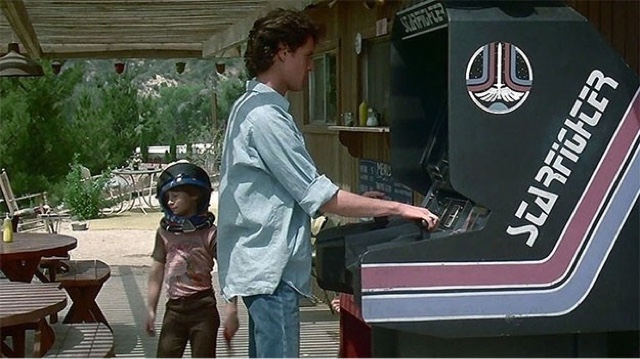
So, I was listening to the soundtrack to the stage musical version of The Last Starfighter today. I only even learned of its existence today, actually. And, it starts off a little goofy, I'm not particularly liking it--production notes online about how they use the trailer park and a picnic table in particular for the trailer park denizens to act out the story, without much else actually seemed like it could be fairly cute, but the music felt immediately wrong in tone for a film that starts so casually, with the sleeping dog and the cat in the mailbox, awnings raising, Otis (Vernon Washington) scraping foot off a plate. Maybe it would be different on stage... I assume it would be different on stage. But, the songs alone don't quite get that same sense that this is a small-knit group of folks who all know each other and are used to passing messages from person to person all the time like they do early in the film when Elvira's (Peggy Pope) power is out and she's gonna m...

nothing like a farm

Image
Matt Melis, writing for Consequence of Sound says, regarding Bernard Malamud's novel's ending—had it made it to the big screen intact: Malamud's ending undoubtedly stands as the more compelling conclusion (and more true to experience); however, I cannot imagine people lining up at the box office to see Roy Hobbs strike out and the movie end with Pop Fisher (Wilford Brimley), Red Blow (Richard Farnsworth), and Bobby Savoy [George Wilkosz] huddled in tears in the dugout. Yep, the novel The Natural ends with a downer. And, it does so deliberately. (Hollywood ruins it.) And I am distracted as the movie gets going because, do you realize that 48-year-old Redford is supposed to be just 19 years old during the first act of this movie? Couldn't be bothered to cast a younger version of himself to carry the first half hour, so he just plays 19. INSERT, me sighing. In his introduction to Malamud's novel, Kevin Baker calls it an "anti heroic tale about a baseball pl...

it's so lifelike and realistic

Image
Let's be clear. Yesterday was full of contradictions. Watch bad movies. Don't watch bad movies. Associate only with those like you. Associate with those different from you. Or everything and anything in between. Just, whatever you do, try if you can to make the world better by doing it. Laugh at whatever makes you laugh. Laugh loudly. Cry at whatever makes you sad. Wail if you must. Rage at the politics (or movies) that disturb you. And lament for failure, in whatever form. Put some thought into what you do and do what makes you happy (barring anything that hurts anyone else). Rant and rave and contradict yourself. It's fun. But, enough about yesterday. Tonight I watched Howard the Duck . I'm not sure if I had watched the whole thing since I saw it in the theater in 1986, when I was 10. I'm sure I had seen parts of it now and then on cable. But, mostly, I had forgotten what supposedly made it so bad. The thing is, it's not that bad. In fact, for 1986, for a fa...

what kind of idiotic joke is this?

Image
I've got Troll 2 playing again, because I wanted to say something more about it. But, I also saw The Dark Tower today, and unfortunately, there are also things to be said about that film in this month of bad movies. Both films have a problem with audience. Troll 2 is ostensibly a family-friendly horror film, but then Holly and Elliott openly talk about sex--she even specifically mentions "group sex"--and Creedence is fairly sexualized as well. Additionally, just watch that scene with Arnold and the girl in the woods and tell me there isn't some serious sexual undertones going on there; girl with a torn shirt running screaming through the woods feels more like a serious R-rated horror film, or some exploitation film from the 70s. (In fact, there's room for an interpretation of this film not just as Joshua's hallucinations but his vicinity to puberty being the fuel even if Grandpa Seth's death was the trigger. Think about it: his grandpa dies and Joshu...

i knew who i was

Image
Two things: 1) When Craig first enters Malkovich's head, he has a piece of wood in his hand. On the one hand, I'm not sure why some random board was sitting in the file room. On the other hand, as Craig points out, that board disappears. On a third hand, the board actually shows back up at the end of the film when Craig is kicked out of Malkovich's head for the last time. 2) There was a piece published on rogerebert.com the other day--"Unfathomable Life: A Writer Grieves for Her Father, Through Five Movies." The title gives it away. Jessica Ritchey writes about her grief and her grieving process by reviewing five movies through 2015. It's remarkably succinct in how big it is, how encompassing of so much of the human experience but also entirely isolated to Ms. Ritchey's experience. It's the argument I make time and time again in this blog--movies can evoke so much, pull us out of our selves, or push us into ourselves just when we need it. Groundhog ...

gimmicky bastard

Image
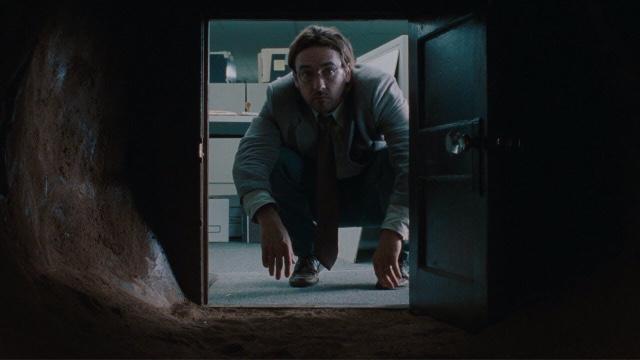
The Craig Schwartz (John Cusack) does awesome puppet shows in Being John Malkovich . Like his author, Charlie Kaufman, he embraces all that his medium is capable of but uses them to tell intimate, and often very internal, stories. There's plenty of room for big stories in movies, spectacles like Mad Max Fury Road (though that certainly has its intimate moments) but sometimes my favorite films are ones like, well, any of Kaufman's. Existential. Personal. And, however much the fictional version of Kaufman in Adaptation. might want to avoid it, they find profundity in the mundane. Craig also gets inside someone else's skin, as he puts it. Which is effectively what any of us get to do when we watch a film.           I'm not sure if Kaufman could write a normal story. Being John Malkovich , before it even gets to the portal into Malkovich's head, involves an oddball reality like--I don't know-- Joe Versus the Volcano ... or a Wes Anderson movie, maybe. Cra...

good for you to get out of your head

Image
The thing that really fascinates me about Charlie Kaufman sometimes is how mundane his early writing credits are. A couple episodes of Get a Life --not the most normal of sitcoms but not as strange as Kaufman's films--a sketch comedy show that I cannot remember if I ever watched ( The Edge ), eight episodes of The Dana Carvey Show , two of Ned and Stacey , and then Being John Malkovich . Like suddenly he had free reign and he embraced it. ( Adaptation. was supposed to be Kaufman coming back around to normal and he both fails and succeeds at this.) I don't know if I ever had that moment when I was writing fiction regularly. I think I actually had the opposite in a way. I started by writing fiction with bits of the supernatural in it. My first novel--the writing of which is awful, but which I would love to rewrite now if I had the time--started as an attempt to take the idea of the virgin sacrifice seriously in a modern context. I think I was picturing the stone sacrificial...

it's self-indulgent. it's narcissistic. it's solipsistic. it's pathetic.

Image
It's also what I do in this blog every day. (Moving on, in this blog at least, from the Oscars.) Adaptation. starts with the fictional Charlie Kaufman (Nicholas Cage) ranting inside his own head, worrying. Then, we cut to billions of years earlier, and time speeds back to the present. The context--Charlie's problems and the history of the world are side by side. Then, we're with Charlie, meeting with Valerie (Tilda Swinton) about adapting Susan Orlean's The Orchid Thief , and he's thinking too much again, but we're with the story. Charlie's muddled thoughts are part and parcel of the story, just as Adaptation. is not just an adaptation of Orlean's book but a film about the idea of adapting the book, adapting book to film, nuanced story to Hollywood, a harried life into something... better if you're lucky. Charlie isn't lucky. But the movie keeps coming back to how we adapt to things. Even one orchid, as Laroche (Chris Cooper) explains to Or...

the whole story from the beginning until now

Image
When you are in the middle of a story, it's isn't a story at all, but only a confusion; a dark roaring, a blindness, a wreckage of shattered glass and splintered wood; like a house in a whirlwind, or else a boat crushed by the icebergs or swept over the rapids, and all aboard are powerless to stop it. It's only afterwards that it becomes anything like a story at all, when you're telling it to yourself or to someone else. --Margaret Atwood, Alias Grace With this quotation, Stories We Tell begins, Michael Polley reading it even before his "narration" begins. think of the story we are telling a twisted, amalgamated beast that eventually becomes history a history written by the winners the privileged hooks' "white supremacist capitalist patriarchy" perhaps most of us knowing only a small piece of the whole many of us lack the capacity or power to substantially alter our place in the larger story some of us but for the grace of god or gods ...

shoot without a script

Image
The film version of Rent starts with a song--"Seasons of Love A"--that doesn't come until Act Two in the stage version. On the one hand, this is because a film, even a musical, doesn't have the two act structure common to stage musicals. But, this song also serves as a sort of love letter to Rentheads who will probably be disappointed by other changes made for the film--from small stuff like Mark never actually calls Alexi Darling to quit his job (seriously, though the lines are there, he's nowhere near a phone), or Mark opening up the film (after that initial transplanted song) with dialogue rather than singing; to big stuff like cutting half of "Goodbye Love" because director Chris Columbus thought it was emotional overload. Similarly, the film never explicitly lets us know that Roger's ex-girlfriend killed herself because Columbus thought that would be "too much." It's a musical about a bunch of poverty-stricken artists, many of w...

abnormal psychology

Image
(Note to my future self: do not cite this entry if you end up doing your thesis on the currently being proposed topic; that would be cheating.) First, let's get this out of the way. Yesterday as Groundhog Day played on my iPad, I was running the movie on the computer as well, skipping around to grab screencaps of the interiors of the Cherry Street Inn. Obviously, that is not the interior. That is the exterior as shot in Woodstock. The interiors, as I mentioned the other day, were in a warehouse in Cary, IL. This is the side of the building (from Google Street View): So, here's the thing I need to get out of the way: Phil's room is designed in such a way that it could not possibly be in this building as it actually exists. Here's my diagram again: The stairs go down to the left there, which would be west since the three windows at the bottom of that diagram look south . Now, if Phil's room was where it should be, at the top right of the Cherry Street ...

i really feel weird

Subtitle: one lingering detail that wasn’t all in voiceover. Just after Phil was “learning how to listen” in Rubin’s original, there’s a scene at a Basketball Court. Phil plays one-on-one with “some TEENAGER.” In the direction, “Phil steals the ball and does a good lay-up. The Teenager calls it a “[p]retty good move for an old guy.” Phil says he practices a lot. (Six months, four to five hours a day, and you’d be an expert.) So, the Teenager says he’s going to practice a lot, too. And, Phil asks him, “Aren’t you supposed to be in classes now?” (Nevermind that in Punxsutawney, they probably get the day off school… despite the frog prince scene as well.) The Teenager responds: “You wanna be my daddy or you wanna play b-ball?” (There’s already some things going on on Groundhog Day regarding parenting and parental roles, but they’re worthy of a separate entry.) Then, it’s the Teenager’s turn to do some exposition, while dribbling: Everybody worrying about my future. I say, “He...