Posts

Showing posts with the label plot

brick not hit back

Image
All that being said, I don't have much of a problem with violence in film. Violence can work really well (if done well) in film. But, I do think that Bloodsport has a cheap structure in building the story around its violence. From the stereotyping in the opening montage of fighters to Chong Li being the villain in the third act because he beat Jackson. It's simple. In fact, as the film is starting, I should mention because 1) I think it is rather silly that everyone turns away from Chong Li when he kills another competitor on the runway, that 2) the first thing we hear about the Kumite (when Jackson is approached while hitting a punching bag) is that you could get killed there. Later, Janice says she heard the Kumite was "unnecessarily brutal" and she compares it to a cockfight. It is silly, by the way, because the only rules we are ever told for the Kumite is how to win--knock out your opponent (unconscious, and dead should certainly qualify), knock your oppo...

it’s good enough for me

Image
Incompetent police force. Jeep commercial disguised as car chase, and I'll get to the racism and sexism later. But, the first moment of genius comes early--Mama Fratelli, driving the getaway vehicle for her son's jailbreak, and she's eating, casually. And that car chase allows for some simple introductions to all of our main characters, and offers details on who they are. Andy (Kerri Green) is a cheerleader... That's all. Cheer captain, I guess. Rosalita (Lupe Ontiveros) is (appropriately, I suppose) jumpy, and maybe not that bright. Police cars have sirens so, for example, you don't get caught in the middle of the crosswalk as they come speeding through. (This characterization might actually matter regarding one of the complaints later. [Or tomorrow.]) Mouth (Corey Feldman) tries to be helpful with his father. And it is not their house, mind you--the Mad Jack's Plumbing truck is parked askew at the end of the driveway with traffic cones in front of it. But, ...

meaningless clues to confuse us

Image
Except , Murder by Death isn't even really a mystery. I mean, it's not like it offers up clues for the audience to solve anything, nor does it even show the detective's discovering useful information for their final solutions (plus all of their final solutions are so far out of left field, and wrong (especially Sam Diamond's (Peter Falk) theory that negates him being himself, which is funny, but ridiculous)). At best, the only things in this film that the audience might be able to figure out along the way, or more importantly, that we see the detectives figuring out, is that there are two dining rooms. Everything else is arbitrary. Which, I suppose is the point. I actually wish I had (back when I was a kid, but also now) more experience with the genre this movie is picking apart. Lionel Twain's (Truman Capote) big speech at the end of the film does however take me in a slightly different direction. But first, here's his rant: You've all been so clever fo...

see you next tuesday

Image
I don't really want to rehash the inherent sexism in a family film made in the 70s--that's just par for the course, another sign of the times that were. At some point, you must take a film on its own terms, let it have its timely biases and its timely treatments of men, of women, of people of color, of varying ethnicities. What then can you take from The Apple Dumpling Gang ? It's an entertaining film. It's funny. It's got heart. It's plot is simple and easy to understand, and Donavan and Dusty ending up a couple is a good ending to the story as offered. That Amos and Theodore ride off with the happy couple and their kids is icing on the cake. But, what really stands out watching The Apple Dumpling Gang after so many years--and I have seen it in the intervening years, probably most recently in the last 10 to 15 years--is just how well put together it's plot is. (Except for one detail.) The Hash Knife Gang--Amos and Theodore--and their antics are barely c...

would you settle for the point...

Image
[(Note: This was mostly written a few hours ago, but I forgot to take my keyboard with me today. I hand wrote some stray thoughts then a few rants bits... You'll see.) My first thought while watching Cutthroat Island was to wonder when it came out. I remembered (accurately, it turned out) it coming out in the mid-90s but it has Mario Kassar listed as producer. My first note: Mario Kassar? - the 80s guy? Sure enough, it' she 80s guy, which explains some of what's going on with this movie. By the way: That's page one. Black then red on this page. The others are more organized. I will try to just type them as is, keep it simple, and save me some time.] Nice confident opening credits. Cold open feels like the cold open of Romancing the Stone , except this is the film, not a setup. Nice sweeping shots--this movie is far too sure of itself. And that score... [later added in red: It gets a little repetitive as it goes on.] Barely begun and trying so damn hard to be glor...

what kind of movie are we going to see?

Image
In no particular order: 1. What matters more--plot or story? Do you want a plot-driven story like an action film or a mystery, or a fairly basic romance? Or does the story matter more? Does each character need to feel like they've got their own story going on? Better yet, how do you define the difference? 2. How important is dialogue in a movie? Do you prefer clever dialogue? Realistic dialogue? How important is the script? What do you think of voiceover? (Side question: does that bullshit-style of voiceover that only exists at the start and end of a film bug the crap out of you as much as it does me? Girls Trip uses that style and opens with flashback moments with the main characters in college and a series of shots of their reunions every few years, and it's all stuff we just don't need. Everything that the opening of the film--especially the voiceover--offers us is something that we'll figure out ourselves later unless we're idiots.) What do you think of char...

all we did is survive

Image
My friend Shari mentioned that one of her problems with Rogue One was that lack of character arcs. And, then I went out to see Dunkirk . And, while I'm all for characters getting arcs and getting their own little stories--and I think I've made the point more than a few times in this blog that I can appreciate the arcs of characters beyond what the finite limits of a particular film allow--but sometimes, 1) I think that a certain kind of story doesn't necessarily need characters to really change as such and 2) you really shouldn't look to Star Wars movies for serious character arcs, anyway. (Sure, characters have their plot arcs, but their changes are shallow, more plot-driven than personality-driven.) And, Dunkirk makes fantastic use of its actors, and offers up characters that are easy to follow, relatively easy to care about, and situations that are both simple enough to follow and surprisingly complicated at times, with sequences cut together out of order just as...

in the shadow of his ass

Image
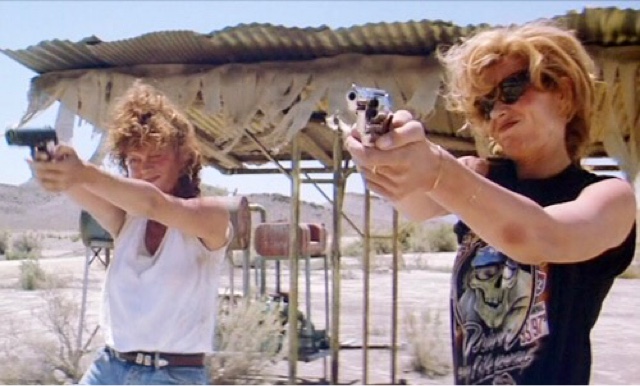
A few complaints before I move on from Thelma & Louise : The simple ones I mentioned in brief parenthetically yesterday . When Thelma and Louise need money, Louise needs Jimmy to get some to her. The talking through of their relationship that comes after her call to Jimmy is an interesting scene, and I'm not sure how the film would really play without it. Louise needs to realize both that she has that relationship waiting, that there is a chance for her in the regular world, and that--remember, when she can't tell him what's going on, Jimmy gets angry and breaks a lamp--even this relatively healthy relationship has an obvious problem: Jimmy is still a male, in a world where men can rage with jealousy and it's accepted. She keeps something from him and, generally speaking, we're supposed to see that as wrong. Here, she's actually protecting him from getting into legal trouble. But Jimmy is still of that man's world, and you don't keep information fro...

it's not a question of money

Image
I never really wrote about the original The Magnificent Seven in this blog. (One of a few times that exhaustion at the end of a long day kept me from really putting in an effort here.) Also, it only just occurred to me, as the men from the Mexican town have come to Chris (Yul Brynner) for help, that aside from one detail--Flik being an outcast from his village rather than a stranger-- A Bug's Life is basically this film, or rather Seven Samurai . And, I'm wondering how I never got that before. It's so obvious. Now, I'm wondering what else I have missed in the movies I've seen, what references went over my head because of particular timing or a lack of familiarity? I have seen Seven Samurai but maybe only once all the way through. It's also the plot of many a D&D module. It's such a simple plot hook--a village is in trouble, and a bunch of men (usually men) have the skills to save it from its attackers. Bring your gunslinging, your knife-throwing...

i had a point

Image
One thing about Big Hero 6 --the reason the film works well despite whatever flaws it might have--is that its structure is basically textbook feature film. You've got your small catalyst at 10* minutes in--Hiro meets Tadashi. Dyer (2010) specifies that the small catalyst be something that "happens to the protagonist, and not... an action that the protagonist takes. We've already got the setup of the status quo. Now, we're moving into what will change it. Notably, it was not getting arrested that turns Hiro around. It was seeing that there were better things that he could do with his intelligence (just as his brother suggested). Dyer also suggests that a character should state the theme of the film early on, and there are important lines the clearly set up the plot, all from Tadashi. He asks Hiro, "When are you going to do something with that big brain of yours?" He asks Hiro, "What would mom and dad say?" And, after offering Hiro a ride, he tel...

we'll print that story when we get it

Image
To think, I only managed yesterday to get through the first three paragraphs of Mary McNamara's Los Angeles Times piece--"Oscars 2016: It's time for Hollywood to stop defining great drama as white men battling adversity." And the first paragraph was just one line. Meanwhile, I've got a screener of Spotlight playing right now. Immediately, I notice the music. Spotlight isn't nominated for Original Score. It is nominated for Best Picture, of course, which is why I'm watching it again this week. It's also nominated for Film Editing, Original Screenplay, Director Tom McCarthy, Supporting Actress Rachel McAdams and Supporting Actor Mark Ruffalo. I've seen a few people and at least one of the articles in this stack in front of me (but I'm not seeing which one at the moment) complain that Ruffalo just puts on an accent. I'm more impressed by his performance, I suppose. It feels like much more than just an accent. He's got a different dem...

people want an authority to tell them how to value things

Image
As a screener of The Big Short plays and I must do my best not to get angry at Wall Street, I really don't want to talk about #OscarsSoWhite today. Spent too much of the last couple days arguing pointlessly about the topic on Facebook and Twitter. A little tired of it... which bothers me, actually. Inevitably it will come up because I have decided to get into the McNamara piece from the Los Angeles Times and that hinges on the race thing. But, I want to talk about McNamara's other angle--plot. See, she starts off with some hyperbole--"The winner of the 2016 Oscar in practically every category is ... white men facing adversity." She's making a point about it being white men, of course, but as she goes she also angles in on the "facing adversity" charge. Her take on the Best Picture nominees: "...with a few notable exceptions, follow a dishearteningly repetitive story line of white men triumphing over enormous odds." Because, of course, triu...