Posts

Showing posts with the label clive barker

is there someone inside you?
Image
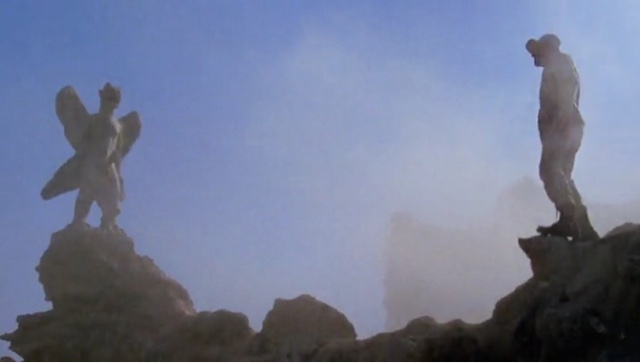
For some reason, every time I watch The Exorcist , I forget that it starts with that sequence at the excavation in Iraq. Of course, the movie is not called The Possessed (though I am pretty sure that I have seen more than one movie with that title); it is not about Regan (Linda Blair) but about Father Merrin (Max von Sydow) and, even moreso, Father Karras (Jason Miller). Something Clover (1992) tries to explain "this gendered division of narrative labor--to understand what it is about the male crisis that needs harnessing to a narrative of female hysteria or indeed psychosis" (p. 70). While Regan's story drives the narrative, the narrative belongs to those two men (and primarily Karras). Man versus the devil. The girl is just their battleground. But, what kind of battleground is she? Kinder and Houston (1987) write about the "psychological interpretation" presented in the film to explain Regan's initial extraordinary behaviour--her parents' divorce ...

i am so exquisitely empty

Image
The thing about the Hellraiser franchise is is started as something different from other horror films. It wasn't just about a string of murders like a slasher film, or some last-minute empowerment of the "Final Girl" to kill the monster. Clive Barker has an interesting take on monsters that he shares with Nigel Floyd of Time Out magazine, September 2-9, 1987: I write the kind of horror fiction in which the monster has to be made peace with, one way or the other. Within the metaphorical world which I create it's not possible to throw the monster out and assume that one's house has been purged. The house can never be purged, because the monster is part of the texture of our internal workings. It's the metaphor thing. Like your classic ghost story, Hellraiser is not about the Cenobites but about Julia and her relationship with Frank, what she will do for him. Hellbound is not about the Cenobites or even Leviathan and Hell; it's about (again) Julia and...

you were all human

Image
Paula Ashe at Ginger Nuts of Horror takes it a little far in saying that, in Hellbound: Hellraiser II , Julia "is no longer working on anyone's behalf but her own, bringing souls back to Leviathan, a god that she has decided to serve." While Julia seems quite willing in all she does here, the murders, pushing Channard into that... thing that transforms him. But, she was willing in the first film as well, even as she operated quite explicitly within the confines of patriarchal society. Paula continues: Julia's purpose is not just concrete, it is now given a spiritual dimension as well, a philosophical motivation that transgresses the basic moral and ethical codes of not just patriarchal society, but civilization itself. This is inference on Paula's part, not any implication that comes from the film itself. Consider: why does Julia emerge from the mattress in the first place? Why did Frank emerge from the floor? Does the blood pull them out unwillingly, or is...

they changed the rules of the fairy tale

Image
Generally speaking, there are two kinds of nightmares: the kind that you actually have, and the kind they make into movies. - Roger Ebert Great line. Of course, he also claims that Hellbound: Hellraiser II "has no plot in a conventional sense." I'm not so sure about that, but, to be fair, it has been a while since I've watched this movie. We'll see soon enough. Opening with pre-Pinhead solving the box works well. He seems to be opening it more out of boredom than some obsessive desire like Frank. And, the quick montage of the creation of Pinhead sets up the end of this film--Dr. Channard (Kenneth Cranham) becoming a Cenobite. But, the closeups on the head wounds-- --invoke some of the imagery of the labyrinth we will see later in the film, as well. On the... agreeing-with-Roger front, Annie Billson wrote in Sky Magazine , February 1989, "This is the kind of film which abandons logic for a non-stop barrage of weird goings-on and ultra-gory special eff...

an experience beyond the limits

Image
Clive Barker talks with Lisa Tuttle in 1991* about creating good gods and bad gods in fiction and he says, I think that is so much more interesting than the division into the white hats and the blacks, between human and non-human, where anything that is defined as "non-human," whether it be slug, shark, crab, Woman, is presented as this terrible threat. It's grotesque, and funny, and simple, and what bothers me is its simplicity. I mind it not because it's grotesque, but because it's simple-minded, and that's boring. You know what I mean? If you turn all of nature into something to be repulsed by, you ignore the fact that whatever is read one way as grotesque or frightening can also be read another way, as something beautiful, as a celebration of variegation and paradox. * original source unknown, but it's reproduced in Clive Barker's Shadows in Eden . I was thinking about why the producers did not want this film to be named, like its source materi...

be gentle with her, okay

Image
In his review of Hellraiser , Roger Ebert asks, "Who goes to see movies like this? What do they get out of them?" Now, he's not (initially) complaining about the despicable content--you know, the sex, the skinless bastard who actively comes on to his niece while pursuing her married stepmother, the Cenobites in all their Catholic priest meets dominatrix garb. He thinks the movie isn't good. I like good horror movies because I enjoy being surprised (and sometimes even moved), but there are no surprises in "Hellraiser," only a dreary series of scenes that repeat each other. What fun is it watching the movie mark time until the characters discover the obvious? This is a movie without wit, style or reason, and the true horror is that actors were made to portray, and technicians to realize, its bankruptcy of imagination. A few points: 1. Roger says "the Cottons buy the house" despite a "kitchen sink... full of maggots devouring rotten flesh....

what's your pleasure, sir?

Image
They could save each other, the way the poets promised lovers should. He was mystery, he was darkness, he was all she had dreamed of. And if she would only free him he would service her--oh yes--until her pleasure reached that threshold that, like all thresholds, was a place where the strong grew stronger, and the weak perished. - Clive Barker, The Hellbound Heart So, I wanted to watch all the Hellraiser films this month. However, the rule about sequels that I cited a few days ago is especially proven true by the Hellraiser series. But, I'm a glutton for punishment--and these films are all about punishment--so I was going to slog through it... Then, I came up with a clever notion--watch them in reverse order so they actually get better as I go. Brilliant, right? Except for the obvious catch--I would have to start with the worst of the lot, Hellraiser: Revelations , the ninth in the series, made so cheaply and so quickly (to hold onto film rights) that they couldn't eve...