Posts

Showing posts with the label other

how long did you think you were in there?

Image
After talking about names , we need to move on to something more about identity in Annihilation . HERE THERE BE SPOILERS. Annihilation , which structurally echoes films like Event Horizon or The Arrival , or an under appreciated tv show from a few years ago called The River , or most any explorer adventure story. It harkens back even to Conrad's Heart of Darkness , except Kurtz and Marlow are on the same trip into the jungle. Or there have been many Kurtzes, including Kane (Oscar Isaac). This is a trip into the unknown taken by characters who are all dealing with loss, with grief, with the universe turned against them. And, in response, they explore because what else is there? They could wait to figure out who they are, or they could act, and hope that in action, the become someone recognizable in the mirror. The film relies on an understanding of the psychological underpinnings of depression but doesn't make much effort to explore them explicitly. Emily Yoshida at Vulture c...

a fatal blow to the racist police state

Image
Escape from New York didn't teach me anything about "white flight", of course . Its premise builds on the concept but the plot doesn't really play with it. Notably in how we never see what life is like for those outside the prison. In 1968, the Kerner Report warned, "Our nation is moving toward two societies, one black, one white--separate and unequal" and "cities will have Negro majorities by 1985 and the suburbs ringing them will remain largely all white unless there are major changes in Negro fertility rates, in migration settlement patterns or public policy" and argued, "The alternative is not blind repression or capitulation to lawlessness. It is the realization of common opportunities for all within a single society." This entry will not all be so dense and full of historical quotes, but it will, as feels inevitable when spending time with Escape from New York , be political. I mean, of course someone like The Duke would rise up ...

a little more like me

Image
There's a moment at the end of The Shape of Water that almost undermines a really nice (but subtly done) theme that runs throughout the film. Oh, assume SPOILERS. (Just skip the next paragraph because the film is worth seeing.) From the start of the film, we know that Elisa (Sally Hawkins) has scars on her neck--one of my lesser complaints is that the film never quite focuses enough on them (though it could easily focus on them too much ) and I didn't even realize until just before the potentially undermining moment happens that she has scars on both side of her neck. Early in the film, when Strickland (Michael Shannon) sits Elisa and her friend and coworker Zelda (Octavia Spencer) down to talk to them, we learn that Elisa was found as a baby near a river, her neck scarred. There's no doubt that these scars (and her having been found by a river) will come into play later. But, I figured on the amphibian man (Doug Jones) either 1) having been responsible for her injuries...

by fair means or foul

Image
Since Blackbeard's Ghost is a kid's film, we won't hear details about the death of Edward Teach--still fighting after his throat was cut, he was felled by at least 5 gunshots and 20 sword cuts--or how he deliberately ran one of his own ships aground so the shares of the loot among the rest of his men would be bigger. Or how he would stick lit fuses in his hat to scare the crap out of people with the cloud of smoke around his head. Instead, we get a pirate who is funny, and an alcoholic. My sister Brooke joked last night that she may have learned to drink from this movie. We also get a kissing booth. And, if this were the romantic comedy it occasionally seems to think it is, that kissing booth offers up the ultimate meet-cute with Steve meeting Jo Anne (Suzanne Pleshette) by kissing her. Incorrectly figuring because she's taking money near the kissing booth that she is working the booth. It's 1968, second-wave feminism in full swing, so after Steve proceeds to als...

nonexistent destroyers of morals

Image
Watching Howl again. Feeling preachy. Feeling political. Tired of so many news stories about refugees, about terrorists, about transgender men and women using the "wrong" bathrooms and scaring all the nice, upstanding, good Christian folk. How dare anyone want to flee a warzone for somewhere safer. How dare anyone lash out at power when they feel impotent. How dare... Actually, those two cover the transgender thing, too. It's all some bullshit war. Christianity being persecuted, of course, because the rest of us (and some of them) don't want them to be allowed to discriminate and hate and hurt and destroy just because "God" says it's okay. And, I'm watching a film. A film about a poem. A poem about a world destroying those who dare to be different, about those who dare to be different trying to destroy the world, or at least to reshape it into something new, something less demanding and restrictive. A film that couldn't exist at the time of i...

i knew who i was

Image
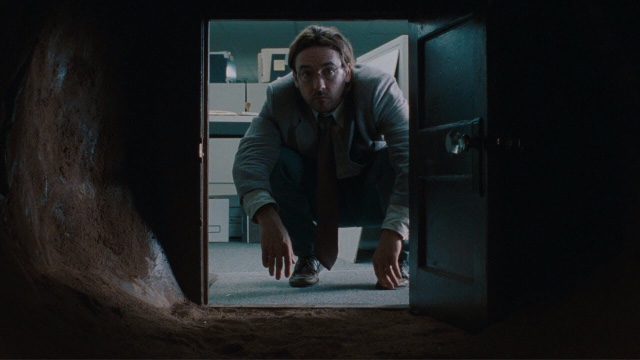
Two things: 1) When Craig first enters Malkovich's head, he has a piece of wood in his hand. On the one hand, I'm not sure why some random board was sitting in the file room. On the other hand, as Craig points out, that board disappears. On a third hand, the board actually shows back up at the end of the film when Craig is kicked out of Malkovich's head for the last time. 2) There was a piece published on rogerebert.com the other day--"Unfathomable Life: A Writer Grieves for Her Father, Through Five Movies." The title gives it away. Jessica Ritchey writes about her grief and her grieving process by reviewing five movies through 2015. It's remarkably succinct in how big it is, how encompassing of so much of the human experience but also entirely isolated to Ms. Ritchey's experience. It's the argument I make time and time again in this blog--movies can evoke so much, pull us out of our selves, or push us into ourselves just when we need it. Groundhog ...

i don't stay in hotels like this

Image
That Anomalisa is set primarily in a hotel, and hotel rooms are virtually identical wherever you go, is as important, I think, as--SPOILERS--all of the puppets aside from Michael (David Thewlis) and Lisa (Jennifer Jason Leigh) having the same face and the same voice. The film relies on existential isolation to tell its story. Making the location as anonymous as the puppet extras is important. They have three of the sets on display at Arclight Hollywood right now, with some of the figures. You can see their faces Here: There is a painting in Michael's hotel room as well that is basically fractal in design--zoom in or out and the image looks the same. Like an echo of Kaufman's Synecdoche, New York ... which I only just learned that a lot of his fans didn't particularly like. I liked it. Anyway, the fractal--the hotel room as a microcosm of the larger world, or a larger living quarters anyway, with the bed, the bath, the toilet, a refrigerator/minibar, a television, and a ...

i'm not afraid anymore

Image
Frank McCallister is deaf or Harry Lyme is an oblivious fool who is as inept at impersonating a cop as he is at robbing houses... Actually, that’s not fair. Harry and Marv do just fine with the whole burglary thing until they get to the McCallister house. But, my point here as I start is... Well, just look: Looking right at him, too. That seems to be Frank sitting just a room away when Harry is looking for adults. Or maybe it’s a ghost, like the ghost of Ted Danson in Three Men and a Baby . Or maybe Harry didn’t really want to talk to any adults, because he can’t handle that sort of thing. He only talks to Marv because Marv is a bit immature. Maybe that’s why Harry turned to crime in the first place; he just cannot handle regular life, holding down a job and that sort of thing. A separate issue (but not so separate, perhaps) arises with Kevin’s tendency to talk to himself, particularly while looking in the mirror. Subramaniam (2008) argues, “When a child is born it is unable at fi...

is that not good?

Image
1. I am currently "watching" Stargate SG-1 - "Window of Opportunity" and playing Carcassonne . I watched Groundhog Day this morning. 2. Yesterday's blog entry was not good. It was so not good that I don't even want to link to it here like I usually would. I do not want that trash just one click away... even though it's right over there in the list of links on the right. 3. Time has passed, so forget #1 and Tru Calling - "The Last Good Day" is on now. Role switch for Tru and Jack, and Tru's father says to Jack some crap about how his role has always been to make sure the day ended just like it did last time. Except, as I have complained before, until Jack showed up in town part way through season one, there was no one making the day change to counter Jack... unless there are rewindy people in every major city. Hell, maybe that's why Phil Connors was repeating his day. He was there to make sure the Old Man died. So, other than the ...

what's your name?

Image
Briefly in class tonight we were talking about the "mean-world syndrome"—a part of George Gerbner's Cultivation Theory that tells us basically that the more we watch television, the gloomier our view of the world tends to be. Essentially, we watch TV shows or the news that includes say violence and murder and, while it's entirely unlikely for a lot of us to actually be exposed to such things in real life, we start to think it's more likely because, well, that's what we know . TV becomes reality. That got me to thinking about Groundhog Day because, well, everything gets me thinking about Groundhog Day . And, I wanted to say, basically, that Phil Connors, even pre-loop, is not a bad guy. I tend to think that fundamentally none of us are bad people. But, sometimes only certain actions of ours get a response, so those actions get repeated. And, we don't even need responses to be positive, we just need them to be . Phil's insults get more immediate resul...

do you have life insurance

Image
An addendum before I get into today's... rambling: it should have been three hotels yesterday . I had forgotten that our coaches trip to Palm Springs happened after this project began. That trip would also make two different cars and a minivan in addition to the four planes. But... It is certainly not the most important aspect of this project--the detail as to all the places I've watched Groundhog Day . Obviously, it's important that I've watched it daily, since that is the point. But... In competitive debate, we talk about class issues a lot, and it occurred to me yesterday that some people don't have the opportunity to a) travel as I have this past year--to Pismo, to Palm Springs, to Salt Lake City, to Woodstock, to Detroit--and b) to waste their time with a project such as this one. Not that I believe it to be a waste of time. It isn't. But, it is certainly the conspicuous spending of time a lot of people simply do not and cannot have. Daughton... (I d...

i've spent a lot of time here

Image
In their essay, “Terminators, Monkeys and Mass Culture," Dimitrakaki and Tsiantis give us a slightly different take on Phil’s experience than Daughton’s (1996) notion that “Phil’s situation… parallels that of the economically disenfranchised, the Other”; Dimitrakaki and Tsiantis tell us “what comes under attack” in the film “is a particular manifestation of cyclical temporality that actually exists in capitalist societies.” One essay’s take on the “cyclical temporality” implicit in Ralph’s line, “That about sums it up for me” matches up with another’s take on Phil’s trap linking to him the disenfranchised, which arguably includes Ralph. That “arguably” of mine is a key point where many might disagree, though. Usually, we would only use “economically disenfranchised” to describe people living, say, below the poverty line, people without many options in their lives, people stuck… well, see, I’m already blurring the definition just enough to be sure I can include the likes of Ralph,...

most of my work is with couples, families

( Enough about religion... for now.) Let's talk instead about something light: psychoanalysis. In the International Journal of Psychoanalysis (87 (2006), 1387-98), Richard Almond tells us that "[i]n the paradigm of the therapeutic narrative, a troubled person plays out his/her typical pattern in relation to an other who is more anonymous, a foil who is depicted in idealized and/or mysterious terms." This "other" is Rita, and Phil is the one undergoing the therapeutic process in Groundhog Day . As I've mentioned before, Claire S. Bacha, in Psychodynamic Counselling (4.3 (Aug 1998), 383-406), claims Rita as "the object of Phil's desire exactly because she seems so much his opposite." Both Bacha and Almond are putting the onus for Phil's transformation, at least in part, on his attachment to Rita, whether it's idealization, attraction, or both. I think I'd side with Almond on this one. Almond tells us that Groundhog Day is of ...