Posts

Showing posts with the label charlie kaufman

i'm trying real hard to be the shepherd

Image
Sunday morning, October 16, 1994, the underground theater in Old Town Pasadena. Officially, it's called the AMC One Colorado. Throughout the 1990s I would go there a lot. This time, I'm there for Pulp Fiction . I had only recently started my subscription to Entertainment Weekly so I'm fairly sure I knew about this film this weekend because I read the review in the Los Angeles Times that Friday morning, sitting in a classroom in Waite Phillips Hall. Discussion section of an anthropology class. I had the Times delivered daily back then, even made an effort to read it, especially the Calendar section. And, I made my way to Old Town for movies as often as I could. I wouldn't work at the United Artists Marketplace a block from the underground theater until '95. Thursday night, February 11, 2016, my living room floor. Groundhog didn't see his shadow last week so winter's over and it's been hot this week. Got a fan to my right, my son Kieran sitting in the ...

where is everybody going?

Image
If any new readers are still here--while this is officially the entry for 2 February, it will get posted close to midnight on the west coast, so it will already be tomorrow for most anyone reading this right away. And later than tomorrow for anyone reading it... later than tomorrow. But, anyway, Groundhog Day is on again, but I want to get a quick recap going first. The last recap entry was Day 884 - every day was exactly the same . (If you're new, that link should get you to an entry that will link you back and link you back and link you back all the way to the initial entries of phase one of this blog--365 days in a row of Groundhog Day .) This, by the way, is an image I found recently online, a nice behind-the-scenes shot of Bill Murray signing autographs. (Unfortunately, that group of kids was not the group of schoolkids that saw Murray beat the fake groundhog against a fence post, or I might have had to figure out contact information for the photographer and see if they kne...

it raises all sorts of philosophical-type questions

Image
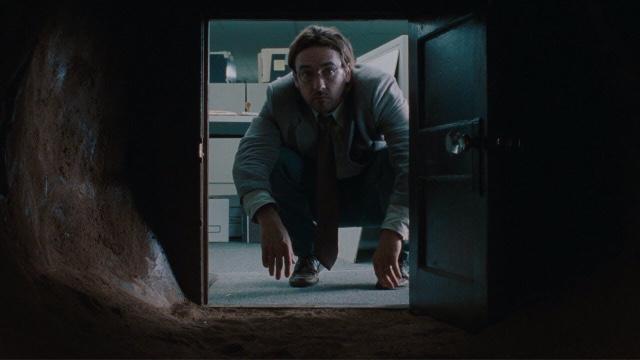
(A note before I get going: I finished yesterday 's entry before the film was over and even before Craig was kicked out of Malkovich after months of living inside him. I mentioned the piece of wood Craig uses but thought it just some random piece of wood. It is not. I noticed it was the edge of a frame when he held it up alongside that New Jersey Turnpike last night and I just confirmed what frame it was tonight as the earlier scene came again. The board is not some random piece of wood. It is the right side of the door frame outside the portal. It comes off the frame when Craig pulls away the board that has presumably been nailed in place over the whole door and frame to hide them. The first thing Craig does when he finds the portal is break it. I don't know if that means anything, but I find it interesting.) I'm reading Dan Hobart's metaphilm review of Being John Malkovich and it's the usual stuff--the film is about "living your life vicariously through...

i knew who i was

Image
Two things: 1) When Craig first enters Malkovich's head, he has a piece of wood in his hand. On the one hand, I'm not sure why some random board was sitting in the file room. On the other hand, as Craig points out, that board disappears. On a third hand, the board actually shows back up at the end of the film when Craig is kicked out of Malkovich's head for the last time. 2) There was a piece published on rogerebert.com the other day--"Unfathomable Life: A Writer Grieves for Her Father, Through Five Movies." The title gives it away. Jessica Ritchey writes about her grief and her grieving process by reviewing five movies through 2015. It's remarkably succinct in how big it is, how encompassing of so much of the human experience but also entirely isolated to Ms. Ritchey's experience. It's the argument I make time and time again in this blog--movies can evoke so much, pull us out of our selves, or push us into ourselves just when we need it. Groundhog ...

gimmicky bastard

Image
The Craig Schwartz (John Cusack) does awesome puppet shows in Being John Malkovich . Like his author, Charlie Kaufman, he embraces all that his medium is capable of but uses them to tell intimate, and often very internal, stories. There's plenty of room for big stories in movies, spectacles like Mad Max Fury Road (though that certainly has its intimate moments) but sometimes my favorite films are ones like, well, any of Kaufman's. Existential. Personal. And, however much the fictional version of Kaufman in Adaptation. might want to avoid it, they find profundity in the mundane. Craig also gets inside someone else's skin, as he puts it. Which is effectively what any of us get to do when we watch a film.           I'm not sure if Kaufman could write a normal story. Being John Malkovich , before it even gets to the portal into Malkovich's head, involves an oddball reality like--I don't know-- Joe Versus the Volcano ... or a Wes Anderson movie, maybe. Cra...

i've been on this planet for forty years and i'm no closer to understanding a single thing

Image
I can relate a bit too well to the fictional Charlie Kaufman in Adaptation. . The awkwardness, the nervousness, always being stuck in my own head. Laroche as well. His obsessions. His movings on. And Susan Orlean. How she wishes she could end things as abruptly as Laroche is capable. How she wants to want something as much as "these people want flowers." This week two new episodes of The X-Files aired after more than a decade without. I used to have a copy of Mulder's I WANT TO BELIEVE poster on my wall... You can see it in this photo of my small, cluttered bedroom in circa June 2000. The other X-Files poster there was signed by a few actors (including Gillian Anderson) and several of the writers of the show at a couple X-Files -specific conventions. Thinking about this conventions just now I found it interesting how I could waiver between different versions of myself in just one day. Awkward and alone through most of the day then happen to be in line with, as you m...

good for you to get out of your head

Image
The thing that really fascinates me about Charlie Kaufman sometimes is how mundane his early writing credits are. A couple episodes of Get a Life --not the most normal of sitcoms but not as strange as Kaufman's films--a sketch comedy show that I cannot remember if I ever watched ( The Edge ), eight episodes of The Dana Carvey Show , two of Ned and Stacey , and then Being John Malkovich . Like suddenly he had free reign and he embraced it. ( Adaptation. was supposed to be Kaufman coming back around to normal and he both fails and succeeds at this.) I don't know if I ever had that moment when I was writing fiction regularly. I think I actually had the opposite in a way. I started by writing fiction with bits of the supernatural in it. My first novel--the writing of which is awful, but which I would love to rewrite now if I had the time--started as an attempt to take the idea of the virgin sacrifice seriously in a modern context. I think I was picturing the stone sacrificial...

it's self-indulgent. it's narcissistic. it's solipsistic. it's pathetic.

Image
It's also what I do in this blog every day. (Moving on, in this blog at least, from the Oscars.) Adaptation. starts with the fictional Charlie Kaufman (Nicholas Cage) ranting inside his own head, worrying. Then, we cut to billions of years earlier, and time speeds back to the present. The context--Charlie's problems and the history of the world are side by side. Then, we're with Charlie, meeting with Valerie (Tilda Swinton) about adapting Susan Orlean's The Orchid Thief , and he's thinking too much again, but we're with the story. Charlie's muddled thoughts are part and parcel of the story, just as Adaptation. is not just an adaptation of Orlean's book but a film about the idea of adapting the book, adapting book to film, nuanced story to Hollywood, a harried life into something... better if you're lucky. Charlie isn't lucky. But the movie keeps coming back to how we adapt to things. Even one orchid, as Laroche (Chris Cooper) explains to Or...

rey, these are your first steps

Image
Took a break from Charlie Kaufman today, was going to try to see one of the few Golden Globe-nominated films I haven't seen yet (the awards are tomorrow), watched Star Wars The Force Awakens again, instead. While there is always room to say more about any given film, I actually do not have much to comment on today. I had considered a response to Andre Seewoods's IndieWire piece about Maz Kanata and what he calls the "othering of the black female body"--in short, I don't totally buy his argument and think he deals a little too much in attractiveness (and winning an award as experience, but that's not that big an issue). I also was thinking about all the plot holes--my three days ( 1 2 3 ) picking apart Seth Abramson's Huffington Post pieces--and getting a little bitter because the Groundhog Day Project doesn't get much play online, people don't get excited by my insights here enough to share all over Twitter or Facebook or what have you... No...

the end is built into the beginning

Image
Synecdoche, New York begins with Caden's daughter singing, then an alarm clock--7:45--and on the radio, a literature professor reads from a translation of Rainer Maria Rilke's "Autumn Day (Herbsttag)" because, she says, Autumn is "seen as the beginning of the end." She compares the year to a life and September is a "melancholy month" in which "the bloom is off the Rose and things start to die." She reads the last few lines: Whoever has no house now will never have one. Whoever is alone will stay alone Will sit, read, write long letters through the evening And wander the boulevards Up and down, restlessly While the dry leaves are blowing Not sure whose translation that one is, but here is Edward Snow's, with the earlier lines: Lord: it is time. The summer was immense. Lay your long shadows on the sundial, And on the meadows let the winds go free. Command the last fruits to be full; give them just two more southern days, Urge them...

this is everyone's experience

Image
Day 888. Eight eight eight. Like three infinities lined up next to one another. A good day to start in on another Charlie Kaufman film, one that deals in a fractal sort of reality, like that painting in Anomalisa . It also deals in depression and paranoia and hypochondria... But really, it deals in a universe where melancholy is the norm and walls burn incessantly and the colour of one's bowel movement is topic of everyday conversation. Synecdoche, New York is the film. Caden Cotard (Philip Seymour Hoffman)--whose name exists somewhere between the alter ego of a superhero and some sad recluse of a man who barley belongs to the same notion of humanity as the rest of us... Actually, he's a bit too close to the latter to really be the former. Caden directs plays. In the first few minutes of the film, we see a production of Miller's Death of a Salesman and already we have a hint of what this is about. This is about death. In the opening sequence at home, Caden misread a h...

i don't stay in hotels like this

Image
That Anomalisa is set primarily in a hotel, and hotel rooms are virtually identical wherever you go, is as important, I think, as--SPOILERS--all of the puppets aside from Michael (David Thewlis) and Lisa (Jennifer Jason Leigh) having the same face and the same voice. The film relies on existential isolation to tell its story. Making the location as anonymous as the puppet extras is important. They have three of the sets on display at Arclight Hollywood right now, with some of the figures. You can see their faces Here: There is a painting in Michael's hotel room as well that is basically fractal in design--zoom in or out and the image looks the same. Like an echo of Kaufman's Synecdoche, New York ... which I only just learned that a lot of his fans didn't particularly like. I liked it. Anyway, the fractal--the hotel room as a microcosm of the larger world, or a larger living quarters anyway, with the bed, the bath, the toilet, a refrigerator/minibar, a television, and a ...

each person you speak to has had a day

Image
"I love doing stop-motion for no reason except that it's stop-motion... My favorite thing is a puppet not moving, just sitting there and being depressed." That's Dino Stamatopoulos, one of the producers of Anomalisa , quoted in the New York Times . And, somewhere in those two sentences, the real genius of Anomalisa is captured--using stop-motion, a format that made the production take three years, to tell what is mostly a very mundane tale-- that is the primary conceit of the latest Charlie Kaufman film. This story could be told in (and actually was before) as a stage play, a single run-through that takes the 9o-minute runtime. But that is rather the point. Taking the time to tell a simple story. That story, though, is really far larger than its mundanity in being so mundane. Dealing with themes of identity, fidelity, attraction, all while playing with the idea of a Fregoli Delusion. That is, one person's inability to tell strangers (and familiars, for tha...

the whole story from the beginning until now

Image
When you are in the middle of a story, it's isn't a story at all, but only a confusion; a dark roaring, a blindness, a wreckage of shattered glass and splintered wood; like a house in a whirlwind, or else a boat crushed by the icebergs or swept over the rapids, and all aboard are powerless to stop it. It's only afterwards that it becomes anything like a story at all, when you're telling it to yourself or to someone else. --Margaret Atwood, Alias Grace With this quotation, Stories We Tell begins, Michael Polley reading it even before his "narration" begins. think of the story we are telling a twisted, amalgamated beast that eventually becomes history a history written by the winners the privileged hooks' "white supremacist capitalist patriarchy" perhaps most of us knowing only a small piece of the whole many of us lack the capacity or power to substantially alter our place in the larger story some of us but for the grace of god or gods ...

you can't be ugly

Image
"What a loss to spend that much time with someone, only to find out that she's a stranger." This comes from Joel's Lacuna tape just before he goes into the hallway to get Clem to stay at the end of the movie. I don't think it's a loss. The intervening time is worth it. I just read The Velveteen Rabbit this evening. For the first time, by the way. The original version, anyway. In case you don't know what that has to do with Eternal Sunshine of the Spotless Mind , there was a monologue about the book. Part of the scene remains but none of the reference to The Velveteen Rabbit . Originally, Clem, in bed with Joel, asks if he knows the book. CLEMENTINE It's my favorite book. Since I was a kid. It's about these toys. There's this part where the Skin Horse tells the Rabbit what it means to be real. (crying, then laughing at herself) I can't believe I'm crying already. [That line sticks around.] (reading from a worn copy of th...