Posts

Showing posts with the label shyamalan

meaningless clues to confuse us
Image
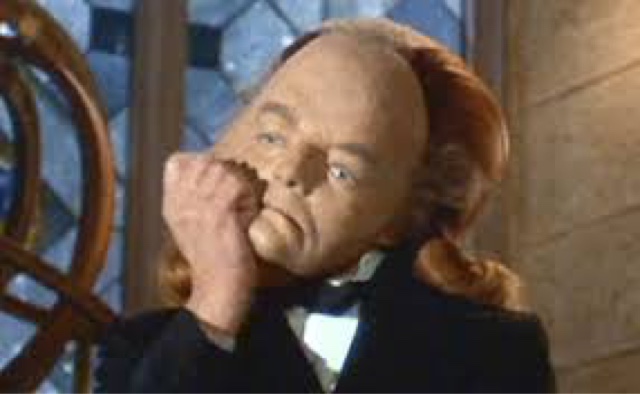
Except , Murder by Death isn't even really a mystery. I mean, it's not like it offers up clues for the audience to solve anything, nor does it even show the detective's discovering useful information for their final solutions (plus all of their final solutions are so far out of left field, and wrong (especially Sam Diamond's (Peter Falk) theory that negates him being himself, which is funny, but ridiculous)). At best, the only things in this film that the audience might be able to figure out along the way, or more importantly, that we see the detectives figuring out, is that there are two dining rooms. Everything else is arbitrary. Which, I suppose is the point. I actually wish I had (back when I was a kid, but also now) more experience with the genre this movie is picking apart. Lionel Twain's (Truman Capote) big speech at the end of the film does however take me in a slightly different direction. But first, here's his rant: You've all been so clever fo...

who survived this terrifying ordeal

Image
Plan 9 from Outer Space is, on its surface, an awful film, far worse than The Happening , but even if you've not seen Ed Wood and seen Johnny Depp's take on the titular director as a man so in love with film he cannot see its flaws, this movie has charm. It's just so... earnest and overwrought; its voiceover is too much, its melodramatic underpinnings are too big for its short running time; and its straightforwardness of plot coupled, its simplicity of sets (like this airplane cockpit which is barely more than a wall with a curtain; they don't even have steering columns), its simplistic acting (without being goofy or inhuman like Walhberg or Deschanel in The Happening ), it's mix of cheap original footage and stock footage, and its ridiculous premise make for a weirdly entertaining thing. Jeff's (Gregory Walcott) rant about how he can't tell anyone about the flying saucer he saw because he's "muzzled by army brass" feels like the kind of ran...

you're not interested in what happened

Image
The one woman's confusion about her book and then stabbing herself in the neck--that's good cinema. The other woman seeing people clawing at themselves, but we don't get to see that clawing--that's just offensive filmmaking. Something Shyamalan does far too much in The Happening ; he has characters and fake newscasters tell us things rather than show us things. And, at the climax of the film, while Nursery Owner has already offered up bits of the explanation for what's happening, we aren't offered visual clues to figure it out, and we don't really get to observe the process of Elliot figuring it out... Okay, we are literally allowed to observe him figuring it out but it's so... lame: Click and see. The construction site scene is a better opening because we see the action. We don't just hear about it. But, the best scene comes later-- (Three hours into the "event" that's happening, we've already had autopsies, we've got a ...

one useless piece

Image
I saw two good movies today. One a horror film, far better than it should have been (though with one annoying flaw right at its center). The other a nice family drama with echoes of last year's Captain Fantastic (which I loved), and based on a true story. That is, Annabelle: Creation and The Glass Castle , respectively. But, right now, I'm watching The Happening because, I suppose I hate myself. Now, The Happening isn't all bad. Until Mark Wahlberg shows up on screen, telling us (or his students) about some article about bees that Shyamalan (or Wahlberg's character, though I'm not sure he has one) read in the news, the movie is actually pretty good. A slow burn handful of minutes, that lady losing her place in her book twice then slowly pushing her hairpin into her neck, all of those bodies leaping from the construction site... And then Elliot (Wahlberg) teaches science but doesn't understand what "theory" means. Cameron Fry has become a princip...

there's something wrong with nana and pop pop

Image
I've complained before about M. Night Shyamalan. Hell, I've complained in this blog about M. Night Shyamalan--primarily Day 375 - used to tell you bedtime stories when I added a viewing of Lady in the Water to my week with The Sixth Sense . I am one of those folks who loved Shyamalan about when he first made it big, then was increasingly disappointed thereafter as the films mostly followed a linear trajectory downward in quality. The Visit is not a great film but it is well above that downward trajectory and it's actually pretty good. Shyamalan dips his feet into the "found footage"* waters with a couple of kids sent to spend a week with grandparents they've never met. * MINOR SPOILERS: "found footage" implies dead protagonists in the end. From the start, given that this involves kids, you can safely assume they will survive. But, The Visit is built on footage filmed by those kids as the older sister, Becca (Olivia DeJonge) wants to make a doc...

de profundis clamo ad te domine

Image
Going to keep it simple to end this week of The Sixth Sense . Going camping for the weekend so I don’t want to linger. (I will be blogging about another film tomorrow. A brief outing to Starbucks in the afternoon for some wifi away from the campsite.) Today: Christ. The Christ- Figure anyway. I will have to track two separate scores today, because I want to measure both Malcolm and Cole. Primarily Malcolm. On to Kozlovic (2009): The first of Kozlovic’s 25 “structural elements of the cinematic Christ-Figure” is that the figure must be tangible, visible and colorful. That’s an easy one for most any character. I’ll give both Malcolm and Cole the point. (M:1,C:1) Structural element #2: being the central protagonist. It might be hard normally to give this one to two characters in the same film, but both Malcolm and Cole do have complete story arcs. Malcolm’s starts one scene earlier and ends one scene later but I’m fairly sure Cole ends up with more screen time to make up for tha...

listen to them

Image
Writing is easy: all you do is sit staring at a blank sheet of paper until the drops of blood form on your forehead. – Gene Fowler Fowler was a journalist, someone who wrote on a regular basis. I don’t know if he considered his output to be art or simply work. Personally, I feel that everything I write, even the most mundane academic piece, is still art. In Art & Fear , Bayles and Orland (1993) begin simply with the following: Making art is difficult. We leave drawings unfinished and stories unwritten. We do work that does not feel like our own. We repeat ourselves. We stop before we have mastered our materials, or continue on long after their potential is exhausted. (p. 1) On the first statement, I wholeheartedly agree. Though writing is easy, making art is difficult, though the two things are often (or, I suppose I implied above, always) one and the same. On the second statement, yes, I have left behind many unfinished drawings, many unfinished stories. I have detailed notes...

used to tell you bedtime stories

Image
Behind the more mundane details, like Malcolm serving as a surrogate for Cole’s absent father, M. Night Shyamalan likes to put big ideas into his movies. Sometimes he’s a little obvious about it. Hell, Lady in the Water basically invents an entirely new mythology just to play at something big. I’ve got Lady in the Water playing beside me right now as I write this, and I’d say this is the point at which Shyamalan really became… well, a joke. Despite many seemingly incorrect notions about comic books, Unbreakable remains a fairly good film, even if it tends to be lesser Shyamalan. Signs , despite an overtly (ridiculously) religious ending, still plays quite well. The Village , with a few minor changes, would be great, but instead is just mostly (that is, through most of the film) good and partly just awful. Lady in the Water --well, it is something else entirely, Shyamalan getting bigger than himself. News reports on war in just the first few minutes of the film remind me of the news...

you have to add some twists and stuff

Image
Interestingly, just as started The Sixth Sense tonight, I notice a link to an io9 article—“ The Cultural Curse of Knowledge and Movie Spoilers ”—that doesn’t deal with The Sixth Sense ’s twist and how everybody knows it, but makes a good point about how those of us who know because we’ve seen the film (or any film with a twist, for that matter) almost can’t help but SPOIL it for anyone and everyone without much deliberation or planning. We just do it, because, as Inglis-Arkell (2014) writes in the piece, “People who have some piece of knowledge, whether it's technical or incidental, have a hard time thinking from the point of view of people who don't have the same knowledge.” For more SPOILERS, by the way, here’s a nice shirt from Threadless : The Sixth Sense is on the right, about a third of the way down: THE KID’S THERAPIST IS A GHOST . That’s the big third-act twist. The twist that made M. Night Shyamalan a household name. The twist that “blind-sided” Roger Ebert (1...

that isn't magic

Image
The Sixth Sense is all about the twist. That is what everyone remembers, even those who haven't actually seen the film. But, I'd like to start my week of The Sixth Sense by reviewing the movie for itself. Mendelson (2014) reminds us, " The Sixth Sense is really about a mother and son learning to communicate [which leads us right out of talking about The Ring for a week] and its real climax, a heart-to-heart conversation in a car, is a heartwrenching powerhouse that would have rendered the film an absolute triumph even without any kind of twist ending." (Another interesting link between The Ring and The Sixth Sense is that not only do we have a single mother and her son at the core, but in establishing that particular relationship/setting, we get the mother in a state of (semi-)undress, walking around the house, a sort of visual shorthand for a certain working-class, small house, tight-knit family closeness that tells us without dialogue that this situation --t...

one of these big blue things

It starts with blue sky—sure there are clouds moving, movie shorthand for the passage of time… Ryan Gilbey, author of the BFI Modern Classics critical study of Groundhog Day , calls this “only slightly less clichĂ©d than the peeling leaves of a calendar.” But, then there’s the bluescreen. Where does Phil point to when he says where he would like to be if he could be anywhere in the world? He says, Elko, Nevada. But, he is gesturing at the blue emptiness. And, he soon warns about “one of these big blue things” coming for Pennsylvania. The next notable blue is Rita. Not Rita herself, obviously; she’s not Smurfette. She’s wearing her blue coat and she’s playing like a child in front of that same blue screen. Fun, but not Phil’s kind of fun. Too innocent, maybe. Minor blue: Kenny’s shirt. Kenny is, presumably, Phil’s assistant. He’s played by Willie Garson. (And Larry’s blue jeans, but I’m not sure if counting blue jeans is fair. Oh, I’m getting ahead of myself, like Rubin’s original scr...