Posts

Showing posts with the label clover

omens of the future

Image
That being said, Carpenter made the choice deliberately to give Halloween II more gore than the original. The director, Rick Rosenthal, was trying to ape the original a little more, but Carpenter altered it, reshot scenes (and I believe shot a few new ones as well). Our friend from the other day , scientist , may think this means Halloween II has gone "off the rails", but the "rails" for films like this were headed toward more gore, toward an increased body count, because, well, that was inevitable. scientist also argues, "The whole point of Halloween is, after all, that its events have no point." But, while the original film may not offer a specific motive for Michael's kills, it does explicitly namecheck " fate ". Every person's fate is to die. Every character in a slasher film (even if at the time, there was no such thing as a "slasher film" just yet) is looking at the possibility that fate will come soon. scientist ...
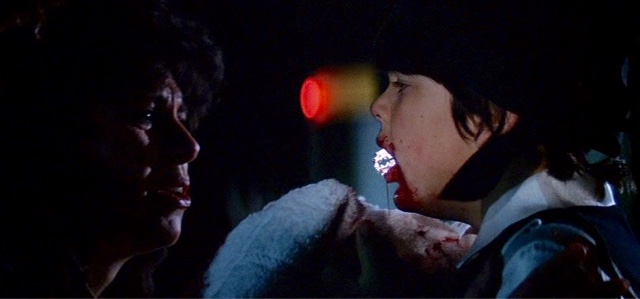
you don’t know what death is

Image
...and I like the gore. But, I will get to that. First, the promised list, films released between Halloween and Halloween II that fit the "slasher" bill (even if they were likely not called that at the time; more likely, they were marketed as "splatter" films or "thrillers" depending on the intended audience. The films are: Driller Killer , Savage Weekend , Tourist Trap , The Hollywood Strangler Meets the Skid Row Slasher -- (How have I 1) never heard of this one, because that title is so amazingly evocative and on-the-nose as to a brilliant piece of art regardless of the film itself (and, it is worth noting, Friday the 13th was marketed based on the title alone, before a script had even been written), and 2) never seen it? Hell, too many of the movies on this list I have not seen. Also, since I am interrupting, a few of the films on this list push the definition of "slasher" a bit, but I was trying to be as complete as I could. And, I...

i don’t even know how to use this thing

Image
When I wrote about Halloween II before , I referred to my younger self, standing around watching the scene in which Loomis tells Sheriff Brackett that he shot Michael 6 times being filmed as "a wee little, impressionable child." Today, when someone on Facebook asked people to post an image of a fictional character that impacted their life, I posted an image of Michael Myers, atop the stairs at the Doyle house in the original Halloween . I wrote about my impressionable self and then I talked about Michael's psychosexual fury (Clover 1987 1992). The slasher film is explicitly tied to visible acts of sex. The kind of thing my mother would try (and usually fail) to cover my eyes for. Not the kills, which were more gory than the original. (I actually only just now learned that the decision to add more gore than the original was Carpenter's decision, not director Rick Rosenthal's. Carpenter supposedly even directed some scenes to make them bloodier. Since the orig...

you'd make a fabulous girl scout

Image
Halloween is only tangentially connected to the classic urban legend about the babysitter and the man upstairs. But common elements to them both are important in the film. This is before the final girl was more defined, keep in mind. Laurie's status as babysitter was less a hallmark to separate her from her friends--remember, Annie is also a babysitter, and Lynda is definitely familiar with Wallace house (though she may have just come by while Annie or Laurie was babysitting before)--but to normalize her. These are everyday, regular teenage girls. They call one another, they call their boyfriends, they call boys for on one another's behalf. Regarding that urban legend about the babysitter, Folklorist Sue Samuelson, who examined hundreds of unpublished "Man Upstairs" stories filed in American folklore archives, concluded that the telephone is the most important and emotionally-loaded item in the plot: the assailant is harassing his victim through the device that is ...

he doesn't see his shadow

Image
Speaking of a repetitive day-to-day, Phil Connors embodies that. I mean, in Pittsburgh, going to the station, repeating the same barely accurate weather information day in and day out, then a little banter with Nan and Kenny, then out on the town to pick up a woman to bring back to his apartment. He's already made his way through the secretarial pool, even has to avoid a few of those women. He's starting to feel as if he will never be able to settle down... at least in the moments that it occurs to him that he should. And, in an earlier incarnation of the script, he has found Stephanie. He didn't mean to treat her badly. He even told her, explicitly, that he didn't have time for a "real relationship." One of these days, a major network is going to call him up and he doesn't want to have to worry about a girlfriend or, worse, a wife, to affect his decision to go. His immediate decision to go, that is. Leave Pittsburgh as far behind him as he did Clevela...

i never want to see or hear from you again

Image
Skipping the rest of the sequels, wary of decreasing quality and inspiration. Moving on to the remake... because I'm still a glutton for punishment. Yay, misquoting (quoting some odd translation I can't find through google , anyway) scripture right away. Skipping details, too. This is definitely an Omen film. The various interpretations of the signs are a stretch, as per usual. And, I don't like the opening of this film as compared to the original. Lame end-of-the-world stuff at the Vatican, cut to Robert Thorn (Liev Schreiber) on his way to the hospital, rushed. The original was so simple and bleak, its opening line--"The child is dead"--said without much emotion. Thorn explains that the child was everything to his wife, which is a rather pointless thing to say. Like we were figuring, Oh, she probably didn't want the kid anyway, everything is fine . Emotion is nice but there was something interesting about Gregory Peck's Robert Thorn, picking to repla...

you don't have to wear that dress tonight

Image
I was saying something about Satine's introduction, performing for the crowd of mostly men in the Moulin Rouge. I think I might skip past the rest of Lacan for now and move on to the feminist critique... Vladimir Propp (1968) lists among the basic dramatis personae the princess . Serving as the princess in Moulin Rouge! , Satine is "a sought for person" and she "cannot be exactly delineated" from her father (p. 79). As I have already said above-- If you haven't been reading this blog the last few days, you should know that much of what I've been writing about Moulin Rouge! I am deliberately repurposing for a paper for my media theory class... or vice versa. Hence, this "above" which actually refers to something I said yesterday or the day before, or maybe both. Just bear with me. --Zidler is just one male figure in this film standing in for the patriarchal order over Satine and her body. Quite specifically, he serves as her father, ...

she is mine

Image
Freud will have to continue a little bit for a couple reasons: 1) there is bit more to say about Freud before I inject some Lacan and 2) I realized that Mulvey doesn't include Jung, so in terms of my paper not being a research paper but an analytical piece based around the supplied readings, I shall leave Jung out of it... even if there may be useful things to say; for instance, much of what Mulvey is trying to argue about how Freudian psychoanalysis connects with common cinematic representation fits with the Jungian idea of the collective unconscious . Effectively, however much a filmmaker intends to put psychoanalytic concepts into a film, they go in anyway. And, even divergent concepts, arguably, exist within film not necessarily because a filmmaker may deliberately be trying to diverge from the norm but unconsciously. But anyway, Freud... Another Freudian idea central to our experience of film, according to Mulvey, is scopophilia , looking as a source of pleasure. The voyeu...

the party's over

Image
A babysitter receives a phone call. The man on the line asks about the children she’s babysitting. After several calls, she calls the police and they trace the next call—it’s coming from a second line inside the house. The version of this story that I know best comes not from someone telling the story around a campfire or wherever but from When a Stranger Calls . Interpretation of this story can go a lot of directions. The babysitter not doing her job thoroughly may stem from fear of such in an age when young women were claiming more independence and, like Jess in Black Christmas rejecting motherhood and other “womanly” ideals. Like the notion (somewhat via Clover (1992)) that female sexuality is being punished in the slasher film, the urban legend of the babysitter and the man upstairs deals in feminine independence (not necessarily or exclusively sexuality) being punished by a man positioned literally and figuratively above her. It’s arguably about patriarchy, paternalism, the punis...

come right out and say it

Image
It’s not just feminism that birthed the slasher film. I’m reminded of CNTV 393 at USC, particularly September 27, 1994. Jess’ announcement—“I’m pregnant”—we only hear from outside the window. We are only in the room in time for Peter’s reaction. Essentially, we are with him , not with her. Not right then. That day in class we watched Ten North Frederick , starring Gary Cooper. I barely remember the movie and only generally recall the notion of “male melodrama.” But, fret not, because I still have my notes. Not the quality of notes I might have from more recent forays in the college classroom, but there’s some useful information. For instance, Professor Casper defined the male melodrama as a movie that “traces a series of adventures, professional labors, and sexual episodes of a male protagonist through which the male comes to some understanding about the meaning of life, usually involving spiritual values.” The movie is, on the surface, not about Peter, yet we are with him again—...

expanding his act

Image
Silent Night, Deadly Night is awesome and it amuses me that the main character is named Billy considering how the killer in Black Christmas calls himself Billy*. Silent Night, Deadly Night falls right in the middle of a big wave of slasher films and is full of blood and breasts and stuff actually happens... unlike Black Christmas . While Nowell’s (2010) argument that Black Christmas was a pioneer film for what would become the slasher genre it almost is not a horror film at all. Instead it’s something more of a drama, with hints of melodrama and interruptions of horror. It’s strange amalgamated structure is on purpose, of course. As Nowell describes it, “It was Canadian and it was the product of a complex network of transnational indutrial shifts that had been unfolding in the late 1960s and early 1970s involving the Canadian government, the Hollywood majors, America’s theater-going youths, and independent filmmakers from around the world” (p. 61). Nowell argues that Black Christma...

stop me

Image
The prank caller in Black Christmas seems to have two very different messages. First, he’s got the whole sex pervert thing going on (with that life-threatening coda in that initial call) then he gets weirder with the baby stuff... and Peter is introduced over the phone. That’s interesting. It occurs to me that the film doesn’t 100% confirm that Peter is not the prank caller. In fact, the change in tone from sexual to something more aggressive would make sense considering his openly negative reaction to Jess’ news about their baby. Of course, I say that “100%” line because of a) the scene in which Peter is there for one of the calls* and b) the twist ending. The movie isn’t bad—let’s get that out of the way. It’s actually pretty good for a Canadian horror film. But, I think it might work better if Peter were the caller/killer instead of just a red herring. The horror works better if it is closer to home. I don’t mean that it always does. I mean for this story, taking place so much w...

i'm not afraid anymore

Image
Frank McCallister is deaf or Harry Lyme is an oblivious fool who is as inept at impersonating a cop as he is at robbing houses... Actually, that’s not fair. Harry and Marv do just fine with the whole burglary thing until they get to the McCallister house. But, my point here as I start is... Well, just look: Looking right at him, too. That seems to be Frank sitting just a room away when Harry is looking for adults. Or maybe it’s a ghost, like the ghost of Ted Danson in Three Men and a Baby . Or maybe Harry didn’t really want to talk to any adults, because he can’t handle that sort of thing. He only talks to Marv because Marv is a bit immature. Maybe that’s why Harry turned to crime in the first place; he just cannot handle regular life, holding down a job and that sort of thing. A separate issue (but not so separate, perhaps) arises with Kevin’s tendency to talk to himself, particularly while looking in the mirror. Subramaniam (2008) argues, “When a child is born it is unable at fi...