Posts

Showing posts with the label history

why are things so heavy in the future?

Image
It's the little thing, really... And not the obvious stuff like one of the clocks has Harold Lloyd hanging from it like Doc will later. I mean, stuff like the broken clock under the table when the dog food spills. The rundown movie theater is a church. The other movie theater is showing Orgy American Style . On the main square there's a sex shop, a pawn shop, a loan shark, a travel office, a psychic, a seedy motel, a couple closed down businesses, and Mayor Goldie Wilson's reelection campaign headquarters. And how weird is it that the diner became a workout gym and then turns back into a diner by 2015? (If that ain't America in a nutshell...) Marty checks out two woman in leotards and Jennifer barely seems to care--but she does notice. She deserves better than this flighty musician. Graffiti on the school says DANGEROUS BOB and I imagined some crew member was referencing the director with that one. But, really, 'Dangerous' Bob Widin was the as...

learned to live again

Image
Talking with Fresh Air about Mad Max: Fury Road , director George Miller says "that a film's reception changes with time. 'First of all, people write about it in reviews and... [then] after a while The audience starts to tell you what your film is...'" I found this when looking for old interviews with Miller, get a better idea of his reasoning for making the original Mad Max or, more importantly, The Road Warrior . But, in this deconstruction going on in this blog of late, that is not necessarily the point. I mean, in 1981, I am five years old. I don't rightly care why a film gets made. If the film entertains me, I am just glad that it got made at all. By '83, when Return of the Jedi comes out, I am buying... Or having my mother buy for me behind-the-scenes books and magazines. I learned about blue screen from a section about the Speeder Bikes. But, I suppose that I might write more about that when I get to Return of the Jedi . What matters today is t...

wait, just wait a minute

Image
I'm watching The Buddy Holly Story tonight. It's already late when I'm starting because, well, because life is a busy thing and I was feeling like I was getting sick earlier today--ended my argumentation class a bit early, even--and slept a bit this afternoon, had to take my daughter to gymnastics this evening. The Buddy Holly Story is an interesting case because it's actually been a good amount of years since I've watched it last... In fact, I don't really remember the last time I watched it, nor the first. And it's not like there are particular times watching it in between that stand out. But, this is movie that I saw plenty when I was young, and by release date, it came next, after Star Wars . This was my mom's movie, really. She grew up on Buddy Holly music. And, that mean's I grew up on Buddy Holly music. And Pink Floyd, and Journey, and Duran Duran... I had my mom's music, my dad's music, and six older sisters' music. Different in...

well, you do seem awfully tied in to these people

Image
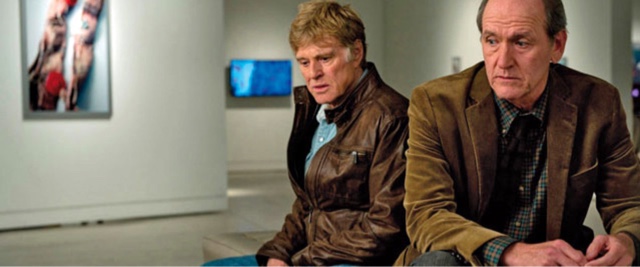
Let us stick with rebels , but (semi-)real ones, and we will take them seriously. The Company You Keep references the Weather Underground right away, uses some news footage-- (Though I'm pretty sure it gives people's names that were not actually part of the organization... and, I trust my impulse here. I've written four papers (one published) about (at least in part) Weatherman (aka the Weather Underground Organization), the most recent just this past spring and I've been meaning to look into getting that one published. Thing is, there a few things I know a lot about in recent years-- Groundhog Day and Weatherman are two of those things. Got a copy of the FBI file and everything. Anyway, my impulse on the name Sharon Solarz (Susan Sarandon) proved correct when we jump forward in time and that's one of our main characters. So, fictional.) --lets us know that this is going to be about the past coming back to haunt the present. A common enough theme. Solarz is ar...

you were very proximal with your grandfather, yes?

Image
Opening shot: close up on amber. Gradually, as the camera moves, we see that there's something in the amber. It's a cricket, or a grasshopper. This bit of amber, from a necklace Augustine wore (in the film version of the story) and presumably gave to Safran, was the first thing--or so it is implied--that Jonathan collected . He took it from the bedside table by his grandfather's deathbed. The thing about a bug in amber--and it's an ant in the book, not a cricket or grasshopper or whatever insect that is from the order Orthoptera--is that it is like time standing still, a remnant of the past. (And, if Hollywood (or Michael Crichton, anyway) can be believed, we can get dinosaurs out of them.) I assumed until I saw a couple people online calling is a cricket that the insect in amber in the movie was a grasshopper. Considering Grandfather's attention, a few times, to the moon, I appreciated the grasshopper's link to the wax and wane of the moon via Japanese tra...

promised land where they could live in peace

Image
This morning in the hotel breakfast room, there was a guy who works on scripts for AMC and the History Channel--their war shows--talking with his friend about script policies. Among other things, he said they had to downplay battles that we lost and to avoid referring to any time that we retreated. Scripts needed "high five" moments. I imagine the Western genre as something a lot like this, promoting the Western myth as fact, though cloaked in fiction. Today, for example, we were driving up the 70 to Roswell, New Mexico and we passed the location where John Tunstall was murdered (a moment we've seen in The Left Handed Gun already this month and that we will see a couple more times; the Billy the Kid story is one that bears repeating. I was surprised at how the location was situated in a nice green valley, surrounded by hills. I seem to recall the location being depicted more like a desert in film. Even when we emerged out of the valley, there were low hills and grasslan...

your times is over and you're gonna die bloody

Image
(Two movies today that were supposed to be on separate days. My schedule--already packed--got changed slightly a few days ago. Because of this schedule change--squeezing these two movies in before a roadtrip-- The Wild Bunch will get most of the words today and I won't get to go off on a tangent about Butch Cassidy and the Sundance Kid as exemplar of a great screenplay. I would recommend, if you're interested in screenplays, that you go read William Goldman's Adventures in the Screen Trade . In the meantime, I suspect an easy theme that will tie these two films together--aside from the violence; that was probably just a product of advances in filmmaking combined with the atmosphere of 1960s America.) Most of the Westerns I've watched this far offer little more than an implication of religion, nothing but the presence of a preacher of some sort. The remake of True Grit , through the voiceover narration only, offers some sense of a deity and a religious worldview. I...

the way americans have of acting out their dreams

Image
OVERTURE Multiple directors and several parts, How the West Was Won is a big movie. So big it was filmed and projected in Cinerama, three projectors running simultaneously with one giant curved screen. I've read that eyelines and whatnot may be a little weird watching this on a flat screen... I'm sure I've seen this movie before, more than once, but that wasn't something I would have been paying much attention to, I'm guessing. Anyway, on to the movie. Oh, the music. Classic stuff, sampled or copied in many a film since. Not too long ago I watched Romancing the Stone (because I was considering it for this blog), and I swear the music over the opening novel sequence is just this music straight, no copy, no reference, just plugged in as is. (If it wasn't it might as well have been.) But, for good reason. This music is Western music. This and that theme from The Good, The Bad, and The Ugly --as iconic, or moreso than, some John Williams stuff for Star Wars ...

am i breaking the fourth wall, here?

Image
What else is left to say? I mean, identity and the presentation of self are both big throughlines in my upcoming master's thesis, but there I will probably be stuck with a lot of the prior scholarship on the topic--a little Goffman, a little Butler with a bit of Munoz maybe. Also in my thesis there's going to be some Weick, a communication theory of his that deals with sensemaking. While he applies it often to organizations, I deal with it on an individual level; it's basically how we make sense of the world around us. (There's more detail to it, but I won't bore you today.) Stories We Tell actually deals in something closer to Weick's organizational sensemaking than any individual sensemaking. The whole Polley/Buchan/Gulkin brood is re-contructing a story together because of the structure Sarah Polley has chosen. Except, they are not working together to do so. She has positioned their various stories next to each other to manufacture one larger story, but it...

the ambiguity of the parentage

Image
I'm reminded of a line I said way back on Day 69 - i don't even have to floss --back in the Groundhog Day phase of this blog-- He isn't just an everyman because he represents each of us. He's an everyman because he represents all of us. But, I get ahead of myself by getting behind myself. What is absent from a great deal of Stories We Tell is Sarah Polley herself. She is present in the majority of scenes in the film (only absent from the past footage that is genuine) but here story is not a part of Diane's story. Now, Acts Two and Three of the this documentary turn this into a story that is very much about Sarah instead, about her parentage and what that means for the bigger story of Diane. It was the weekend of Sarah's 11th birthday that her mother died. Eleven years old, her mother dying from cancer--there is no way that Sarah cannot remember it. It is acknowledged within the film that Sarah did not know that her mother was dying when her older siblin...

discrepancies in the stories

Image
So... the twist. Let us just get this out of the way on this Day Two with Stories We Tell . SPOILERS ahead, of course. Not that you would normally think of a documentary as having SPOILERS even be a possible thing. So, Stories We Tell is built of multiple interviews about Diane Polley, director Sarah Polley's mother, and a whole lot of amateur footage of her--Michael Polley explains early on that he bought a camera around the time they met and took to filming much of their lives. Before we get to the big SPOILER, I offer this critique of the film's overall structure from Harry Gulkin, who it turns out is Sarah Polley's biological father--that is not the twist, but it is a notable turn in the course of the story here. Asked what he thinks of giving equal weight to everyone's version of the story, he replies: I don't like it. I think that it takes us into... into a very wooly... You can't ever touch bottom with anything then. We're all over the place. I ...